


Modeling the Marxist-Nationalist Vision of Xi Jinping Through the Lens of Capacity-Based Monetary Theory
Introduction to the Evolving Geopolitical Economy
The contemporary global economy has entered an era defined by a systemic competition that transcends traditional ideological rivalries, manifesting instead as a fundamental clash of economic and industrial architectures. As the international system navigates the mid-2020s, the strategic orientation of the People's Republic of China (PRC) under the absolute leadership of Xi Jinping has emerged as the central variable in both international relations and macroeconomic forecasting. A profound distillation of this strategic framework was articulated in the July 2026 discussions featured on The Ezra Klein Show, featuring Kevin Rudd, the former Prime Minister of Australia and President of the Asia Society. Rudd, leveraging decades of high-level diplomatic experience and rigorous academic scholarship, identifies Xi's guiding philosophy as "Marxist Nationalism"—a paradigm that systematically unwinds the pragmatic, market-oriented consensus established by his predecessors to forge a fundamentally different future for the Chinese state.
To rigorously analyze the efficacy, sustainability, and global implications of the various visions of China discussed by Rudd, traditional neoclassical macroeconomic models prove empirically insufficient. Neoclassical frameworks, which rely heavily on supply-and-demand equilibrium, short-term financial optimization, and frictionless global trade, consistently fail to account for state actors that deliberately sacrifice short-term economic growth, equity valuations, and consumer prosperity to achieve long-term structural dominance. Consequently, this analysis deploys the rigorous framework of Capacity-Based Monetary Theory (CBMT) to model China's historical and current strategic trajectories.
Capacity-Based Monetary Theory provides an ontological redefinition of money and value. It moves beyond the classical definitions to understand wealth fundamentally as the monopolization of future productive capacity. By modeling the macroeconomic environment as a series of formal game-theoretic interactions—specifically addressing the "Prisoner's Dilemma of Future Value" and the "Hobbesian Trap"—CBMT offers a highly precise theoretical lens through which to evaluate Xi Jinping's strategy of industrial supremacy, supply chain weaponization, and authoritarian consolidation. Furthermore, this framework allows for a nuanced assessment of China's domestic social contract, which is currently undergoing a violent restructuring under the weight of a severe real estate crisis, youth unemployment, and the shifting expectations of the Chinese populace. Through this comprehensive lens, the analysis will determine material deviations from optimal capacity modeling, inherent flaws in the Marxist-Nationalist vision, and the evolving state of the Chinese domestic pact.
The Ontological Architecture of Capacity-Based Monetary Theory
Before applying Capacity-Based Monetary Theory to the Chinese macroeconomic state and its historical visions, it is necessary to establish the theoretical parameters of the model. For centuries, the fundamental question of what constitutes money has bedeviled economists, jurists, and political philosophers. Introductory macroeconomic texts universally rely on a tripartite definition of money: it functions as a medium of exchange, a unit of account, and a store of value. While this definition accurately describes the mechanical functions of money, CBMT argues that it fails to adequately explain what money is in a true ontological sense.
Under the framework of CBMT, money is ontologically defined as a formalized, enforceable claim on future productive capacity. In a globalized environment characterized by extreme technological velocity and profound structural fragility, pure financial metrics—such as market capitalization, fiat currency reserves, or abstract equity valuations—often mask severe underlying production crises. The CBMT framework models global supply chains—ranging from advanced memory semiconductor architectures to critical mineral refinement—not as fluid markets naturally seeking price equilibrium, but as zero-sum battlegrounds for capacity hoarding.
The Prisoner's Dilemma of Future Value
Central to Capacity-Based Monetary Theory is the application of formal game theory to macroeconomic investment horizons. In a standard globalized market, economic actors, whether they are multinational corporations or sovereign nation-states, face a classic Prisoner's Dilemma regarding capital allocation and industrial strategy. The puzzle, originally designed by Merrill Flood and Melvin Dresher in 1950 at the RAND Corporation, involves two rational agents who can either cooperate for mutual benefit or betray their partner for individual gain.
Let the strategies available to an economic agent be $C$ (Cooperate by investing in long-term, structurally sound, capital-intensive productive capacity) and $D$ (Defect by extracting short-term financial rents, engaging in speculative financialization, or prioritizing immediate consumption over investment).
The mathematics of the dilemma dictate that while mutual cooperation $(C, C)$ yields the highest aggregate future value for both agents, defecting $D$ remains the strictly dominant rational strategy for an individual agent in a single, isolated interaction. In Western neoclassical systems, the structural pressures of quarterly earnings reports and brief electoral cycles create a systemic, unavoidable bias toward $D$. This constant defection results in the chronic underinvestment in physical infrastructure, the atrophy of deep-tech manufacturing, and the vulnerabilities of deindustrialization.
The Geoeconomic Hobbesian Trap
When the Prisoner's Dilemma is elevated from corporate interactions to the geopolitical level, it engenders what game theorists term the "Hobbesian Trap". The English philosopher Thomas Hobbes famously described the "state of nature" as a condition of perpetual war, driven by a bilateral fear of imminent attack or betrayal. Without outside influences or binding, globally enforceable contracts, this situation inevitably leads to a fear spiral—a Nash equilibrium characterized by mutual distrust and destructive arms races, where defensive posturing directly leads to increasing fear in the opposing party.
In the context of CBMT and the modern global economy, the Hobbesian Trap manifests as supply chain weaponization and extreme protectionism. If Nation A perceives that Nation B is attempting to leverage monopolistic control over a critical capacity—such as rare earth element refinement or the production of advanced logic semiconductors—Nation A is rationally compelled to preemptively defect. This defection takes the form of raising tariffs, imposing draconian export controls, or aggressively subsidizing its own redundant domestic capacity. The ontological view of money under CBMT dictates that whoever controls the fundamental, physical capacity of the future economy holds the true wealth of the world, rendering abstract financial reserves inherently vulnerable to the strategic whims of the capacity-holder.
Modeling the Historical Visions of China Through CBMT
To fully grasp the magnitude of Xi Jinping's current trajectory, it is vital to utilize CBMT to model the various historical visions of China that preceded him, as discussed by Kevin Rudd. The modern history of the Chinese Communist Party (CCP) can be divided into three distinct ideological eras, each representing a drastically different approach to the accumulation and deployment of productive capacity.
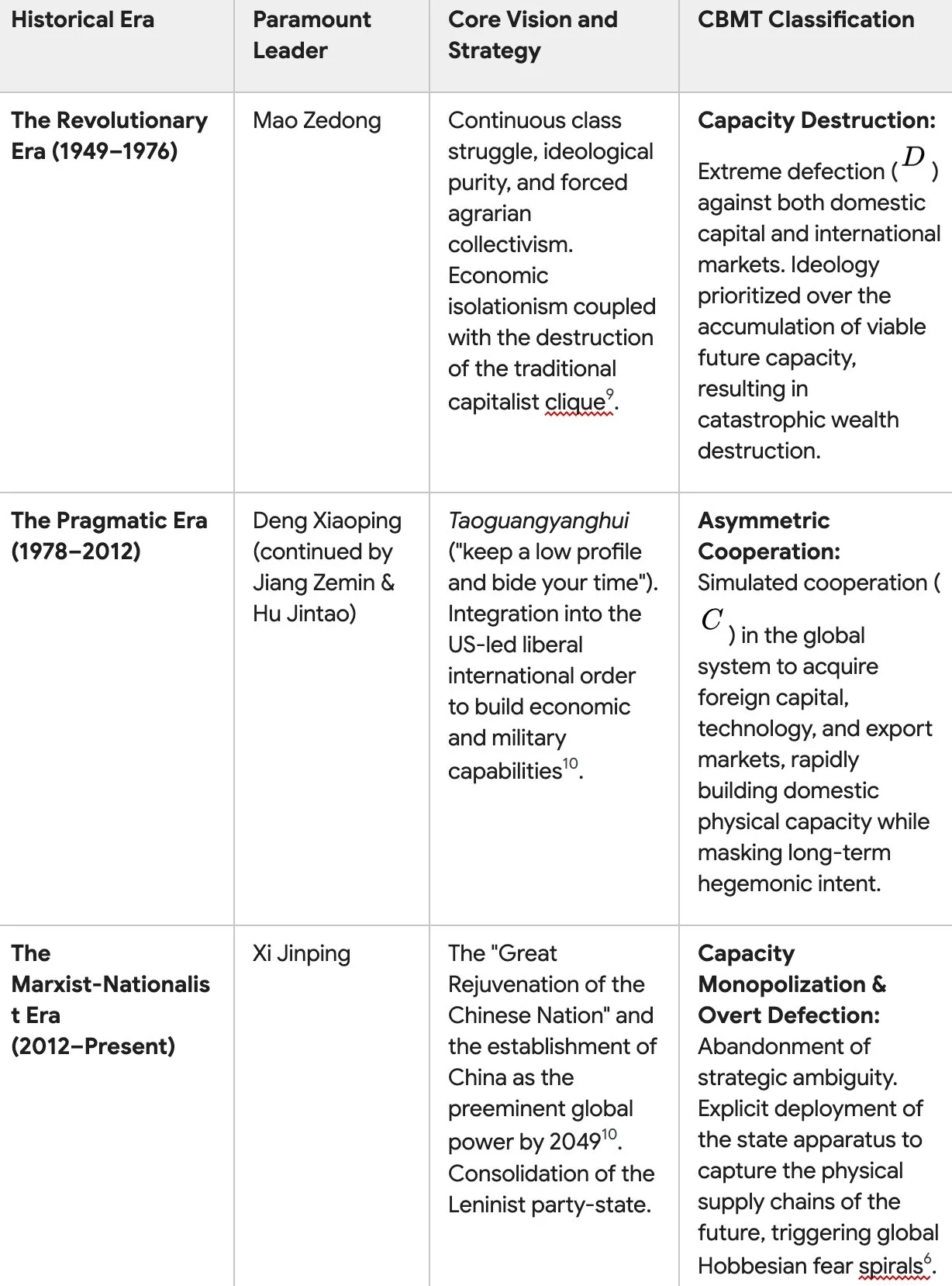
The Deng Xiaoping Consensus: Asymmetric Capacity Accumulation
Following the devastating capacity destruction of the Maoist era, Deng Xiaoping fundamentally rewrote the CCP's operational code. Deng recognized that China could never achieve great power status without first building an immense base of physical and technological capacity. His foreign policy strategy, taoguangyanghui, mandated that China must avoid conflict, accept a temporary American hegemony, and quietly accumulate power.
Through the lens of CBMT, Deng executed a brilliant strategy of asymmetric cooperation. By integrating into the World Trade Organization and presenting China as a cooperative partner in global supply chains, Deng suppressed the international Hobbesian Trap. Western nations, operating under neoclassical models that prioritized cheap consumer goods and short-term corporate profits, eagerly outsourced their physical manufacturing capacity to China. The implicit social contract forged during the Deng, Jiang, and Hu eras was strictly developmental: the CCP guaranteed rapidly rising living standards, urbanization, and personal wealth accumulation in exchange for unquestioned political obedience to the Party.
The Marxist-Nationalist Vision of Xi Jinping
Kevin Rudd's analysis outlines a stark, deliberate departure from the Deng consensus under Xi Jinping. Xi views the global arena not as a collaborative marketplace, but through the lens of historical determinism, Marxist economic theory, and deep-seated Han nationalism. His vision is explicitly articulated through the "Two Centennial Goals," culminating in the transformation of China into a "fully developed, rich, and powerful" nation by 2049, the 100th anniversary of the founding of the People's Republic. Furthermore, Xi has prescribed a view of history wherein the world is most stable when China is the preeminent, technologically advanced, and civilized power—a status he intends to reclaim on China's own terms.
Rudd's analysis highlights that Xi's China has evolved into a rigid Leninist party-state that has pivoted aggressively toward absolute central control. Xi does not optimize for consumer prosperity, the expansion of the middle class, or short-term GDP growth. Instead, his organizing principle is the construction of the world's most powerful, self-sufficient industrial state. To Xi, private entrepreneurs, consumer markets, and domestic capital allocators are merely tools subordinate to the strategic, capacity-building imperatives of the state.
This Marxist-Nationalist vision incorporates several critical operational directives designed to capture global capacity: The primary objective is to dominate the absolute foundation of the future economy, specifically advanced batteries, critical mineral refinement, renewable energy infrastructure, and the entire artificial intelligence technology stack, from physical chips to cloud infrastructure. To achieve this, the state engages in predatory subsidization. Capital is directed to subsidize industrial production far below the marginal cost of production until foreign competitors face insolvency and fold. Once global capacity is successfully captured and foreign alternatives are destroyed, monopolistic rents can theoretically be extracted. Concurrently, the deployment of absolute surveillance—including facial recognition, spatial tracking, and digital payments—acts as a dual-purpose mechanism of both internal political stability and massive data extraction to feed the AI infrastructure.
Modeling Xi's Vision Within the CBMT Framework
When Xi Jinping's strategy is subjected to the rigorous Capacity-Based Monetary Theory framework, it becomes evident that Beijing is attempting a highly sophisticated, state-level optimization of the Prisoner's Dilemma of Future Value.
Resolving the Domestic Prisoner's Dilemma via Coercion
In a purely free-market, neoclassical system, the rational impulse of individual actors is to defect toward short-term rent-seeking behaviors. This typically manifests as real estate speculation, financial engineering, or the creation of asset-light software monopolies, resulting in the atrophy of capital-intensive physical industrial capacity—a phenomenon widely observed in the deindustrialization of the West.
Xi Jinping utilizes the formidable apparatus of the Leninist party-state as the ultimate enforcer to artificially alter the payoff matrix of the domestic Chinese market. By systematically dismantling the power of consumer technology monopolies, heavily regulating the private tutoring sector, and actively deflating the heavily leveraged real estate bubble, the CCP has forcibly eliminated the highly profitable Defect ($D$) options for domestic capital. Capital, engineering talent, and labor are instead coerced into the Cooperate ($C$) strategy: investing in deep technology, advanced manufacturing, and strategic infrastructure.
Through the ontological lens of CBMT, Xi has accurately diagnosed that true superpower status is not derived from the accumulation of foreign exchange reserves or the market capitalization of consumer internet companies, but from the physical capacity to manufacture the future.
The Strategic Advantages of the Vision
Applying the CBMT framework allows for an objective assessment of the structural advantages embedded within the Xi Jinping doctrine. Unlike Western democracies, which are heavily constrained by the quarterly profit demands of financial markets and the vicissitudes of brief electoral cycles, the CCP operates on multi-decade horizons. This temporal advantage aligns perfectly with the optimal long-term capacity generation mandated by CBMT.
Furthermore, the ability to orchestrate the entire macro-economy and industrial base—synchronizing raw material extraction, refining, battery production, and vehicle assembly—creates immense economies of scale and network effects that fragmented, purely free markets struggle to match. By viewing the economy through an ontological lens rather than a purely financial one, China builds resilience against abstract financial shocks. As long as the factories, energy grids, and supply chains remain physically intact and operational, the state maintains true economic power, regardless of fluctuations in domestic or international equity markets.
Material Deviations from CBMT Predictions
While Xi's Marxist-Nationalist vision appears theoretically robust when mapped onto the goals of capacity hoarding, an exhaustive application of CBMT reveals profound material deviations and structural vulnerabilities in the execution of this model. China is currently experiencing systemic friction that indicates the model is not functioning optimally.
The Premature Activation of the Global Hobbesian Trap
Perhaps the most critical deviation from optimal game-theoretic strategy is China's premature activation of the international Hobbesian Trap. Deng Xiaoping's strategic genius lay in maintaining a cooperative facade in the global arena, delaying the geopolitical fear spiral for as long as possible.
Xi Jinping's explicit, public articulation of the "Chinese Dream," his stated deadlines for global preeminence by 2049, and his overt weaponization of supply chains signaled a definitive defection to the international community. As dictated by the mechanics of the Hobbesian Trap, this overt posture has triggered a rapid, reciprocal fear spiral. The United States and its allies have abruptly abandoned cooperative trade frameworks in favor of aggressive, defensive posturing. This includes enacting stringent export controls on advanced semiconductor manufacturing equipment, heavily subsidizing the reshoring of critical manufacturing, and implementing prohibitive tariffs on Chinese electric vehicles and green technology. By telegraphing his intent to capture global capacity before achieving absolute self-sufficiency, Xi provoked the very containment strategy that now threatens to throttle China's export-driven industrial machine.
The Ontological Destruction of Wealth: Stranded Assets
CBMT strictly distinguishes between productive capacity and sterile capacity. The most glaring deviation in China's economic model is the catastrophic misallocation of resources into non-productive infrastructure and real estate. Driven by the political directive to maintain artificial GDP growth targets over the past two decades, local governments and property developers amassed vast physical capacity in the form of unoccupied housing and redundant civic infrastructure.
In structural economics, these are defined as "stranded assets"—investments that have suffered premature devaluation due to shifts in societal demand or technological progress. CBMT penalizes the creation of stranded assets because they consume massive amounts of raw materials, labor, and energy without yielding any future productive value. The sheer scale of China's real estate overhang represents a massive destruction of ontological wealth, directly contradicting the CBMT goal of optimizing future productive power. The capital sunk into empty concrete towers cannot be easily rotated into semiconductor fabrication or advanced robotics.
The Paradox of Centralized Innovation
A further inherent flaw in Xi's vision is the paradox of centralized innovation. CBMT requires that future capacity be fundamentally viable, pushing the frontier of technological relevance. While authoritarian coercion can successfully force capital into scaling existing technologies (like solar panels and batteries), it struggles to mandate disruptive, zero-to-one innovation.
Empirical analysis of scientific output indicates that early-career researchers drive the most disruptive science, while rigid, hierarchical systems suffer from a "nostalgia effect" that stifles true innovation, as older scientists cling to past paradigms. Xi's insistence on absolute ideological conformity, the pervasive surveillance state, and the prioritization of the Party's interests above all else creates an environment deeply hostile to the localized, organic risk-taking required for the next generation of technological leaps. By demanding total political loyalty, the state inadvertently suppresses the intellectual capacity required to sustain the physical capacity it seeks to build.
The Fraying of the Social Contract: Real Estate and Youth Disillusionment
The transition from the pragmatic era of Deng to the ideological era of Xi has fundamentally ruptured the Chinese social contract. For forty years, the CCP's legitimacy rested on a simple, unspoken agreement: the state provides unprecedented economic growth and personal enrichment, and the citizens relinquish political rights. The physical manifestation of this growth was the real estate market, which became the primary vehicle for household wealth accumulation.
Recent macroeconomic indicators illustrate a profound, engineered contraction in the foundation of this old social contract. According to the National Bureau of Statistics of China, the investment in real estate development experienced a severe, structural contraction in 2025.
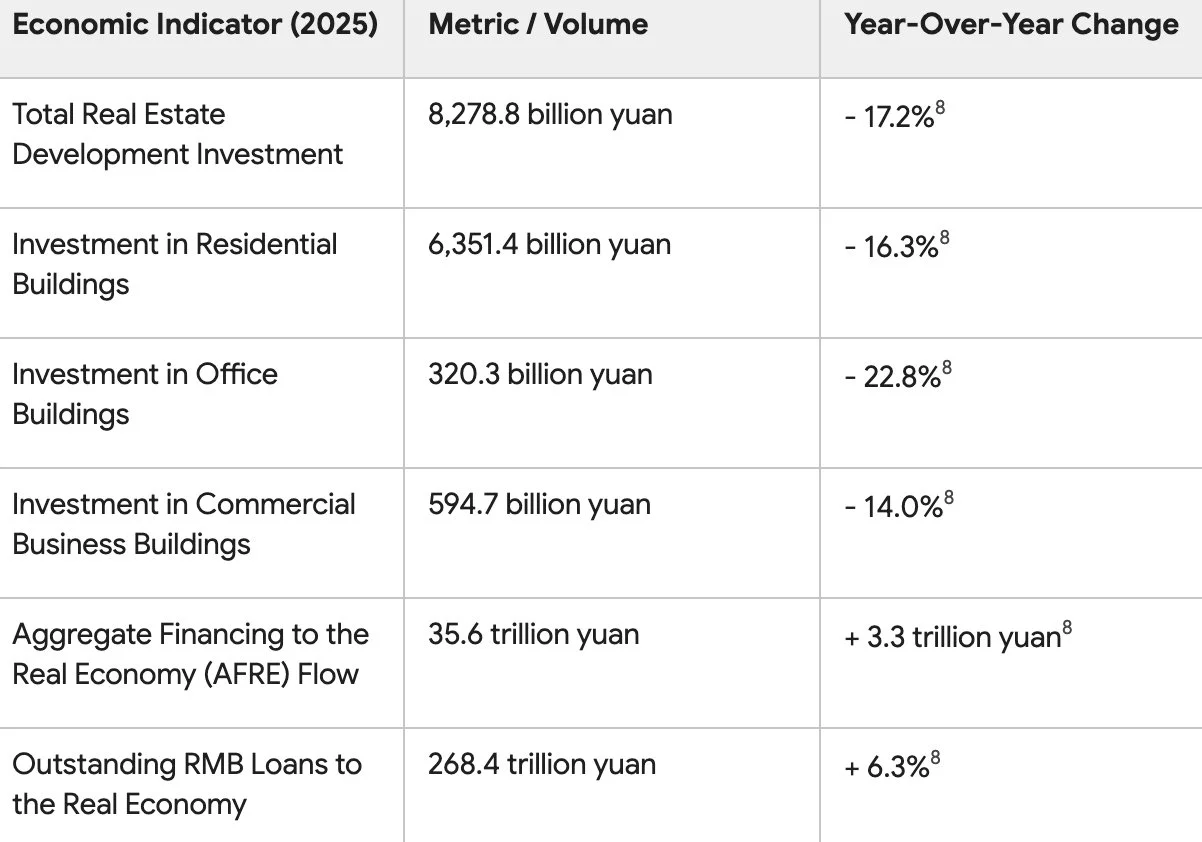
This data reveals a critical macroeconomic divergence: the state is aggressively pumping credit and liquidity into the "real economy"—defined by Xi as manufacturing, strategic infrastructure, and state-backed high-tech enterprises—while deliberately allowing the real estate sector to violently deflate.
Youth Unemployment and the Mandate to "Eat Bitterness"
The pivot from a real estate and consumer-services-led economy to a hard-tech, industrial juggernaut has severely disrupted the labor market, particularly for educated youth. The service sectors that typically absorb university graduates, such as consumer technology platforms, private tutoring, and finance, have been heavily regulated or outright suppressed in favor of advanced manufacturing and engineering.
In response to the resulting surge in youth unemployment and diminished economic prospects, Xi Jinping has not offered Western-style stimulus checks or a bolstered social safety net. Instead, he has deployed the rhetoric of Marxist Nationalism, bluntly instructing the younger generation to chi ku—to "eat bitterness".
This represents a perilous evolution of the social contract. The CCP is now demanding ideological devotion, nationalistic fervor, and immense personal sacrifice without the reciprocal guarantee of upward economic mobility. While nationalism remains a potent force in China—fueled by historical grievances regarding a "century of humiliation" and genuine pride in China's recent technological ascent—the endurance of the populace is finite. The massive, nationwide protests against the zero-COVID lockdowns in late 2022 served as a stark warning. Citizens explicitly demanded "food, not nucleic acid tests" and "dignity, not lies," demonstrating that there are hard limits to how much bitterness the population is willing to consume in the name of the state's geopolitical goals.
Strategic Interventions: Improving the Marxist-Nationalist Vision
To secure the long-term sustainability of the Chinese state, the current Marxist-Nationalist vision must evolve to reconcile its internal economic contradictions and mitigate the global Hobbesian Trap it has triggered. Viewed through the analytical framework of CBMT, several structural improvements can be modeled.
Internalizing Capacity Consumption
The most glaring flaw in Xi's economic model is the massive disconnect between infinite, state-subsidized capacity generation and finite domestic demand. China must shift its focus from purely supply-side subsidization to demand-side empowerment. This requires the establishment of a robust social welfare system, comprehensive healthcare, and secure pension guarantees. By alleviating the severe precautionary savings motive of the Chinese household, the state can unlock massive domestic consumption.
Under CBMT, this does not represent a retreat from capacity building, but rather a necessary completion of the economic circuit. If Chinese consumers are empowered to purchase the outputs of Chinese industrial capacity—such as electric vehicles, green energy infrastructure, and domestic semiconductors—the state radically reduces its vulnerability to Western tariffs and export controls, effectively insulating its capacity base from foreign geopolitical coercion.
De-escalating the Hobbesian Fear Spiral
Xi Jinping's aggressive diplomatic posture and overt declarations of global supremacy have proven strategically counterproductive. To stabilize the international environment and preserve access to global markets, Beijing must re-introduce a degree of strategic ambiguity. While China may continue to build its internal capacity, it must actively manage the perception of its external intentions.
By returning to a modified, modern iteration of Deng's taoguangyanghui, China can ease the bilateral fear driving the international Hobbesian Trap. This involves identifying and acting upon areas of genuine mutual cooperation with the West, thereby reducing the immediate, rational incentive for Western powers to preemptively defect through total economic decoupling.
Repurposing Stranded Assets
To address the ongoing real estate crisis, the state must aggressively accept the reality of its stranded assets. Rather than allowing abandoned residential blocks and commercial real estate to fester as dead capital, the state should utilize its centralized power to execute structural transitions. Obsolete commercial office towers and unfinished residential complexes must be rapidly repurposed into data centers, urban vertical farms, or highly subsidized public housing. This converts a negative draw on macroeconomic sentiment back into a functional, albeit altered, component of national productive capacity.
Conclusion
The strategic vision of China under Xi Jinping represents a grand, historically unprecedented experiment in macroeconomic statecraft. By utilizing the formidable machinery of a Leninist party-state to enforce the dictates of Marxist Nationalism, Xi is attempting to bypass the short-term financialization and rent-seeking behaviors that currently plague Western neoclassical economies. Viewed strictly through the lens of Capacity-Based Monetary Theory, Xi is executing a highly rational, ruthless strategy to capture the true ontological foundation of global wealth: the physical supply chains of the future.
However, this model exhibits severe material deviations from theoretical perfection. The deliberate suppression of domestic consumption, the catastrophic misallocation of capital into stranded real estate assets, and the premature triggering of a global Hobbesian fear spiral threaten to undermine the entire geopolitical project. Domestically, the social contract has been stretched taut, shifting abruptly from the promise of shared prosperity to the demand for national sacrifice and the "eating of bitterness" amid rising youth unemployment.
If Xi Jinping's China is to achieve its stated goal of great national rejuvenation by 2049, it must recognize that absolute authoritarian control is subject to the law of diminishing returns. The true test of the Marxist-Nationalist vision will not simply be its ability to forge steel, manufacture legacy semiconductors, or silence dissent, but its capacity to adapt to the complex, non-linear realities of both human nature and global macroeconomic equilibrium.
-
The Ezra Klein Show - Apple Podcasts, https://podcasts.apple.com/mx/podcast/the-ezra-klein-show/id1548604447?l=en-GB
What Xi Jinping Wants - The Ezra Klein Show - Apple Podcasts, https://podcasts.apple.com/us/podcast/what-xi-jinping-wants/id1548604447?i=1000776737823
Cyber Nationalism and Regime Support under Xi Jinping: The Effects of the 2018 Constitutional Revision - ResearchGate, https://www.researchgate.net/publication/346029744_Cyber_Nationalism_and_Regime_Support_under_Xi_Jinping_The_Effects_of_the_2018_Constitutional_Revision
Beijing's Leninist-Nationalist – Samuel Gregg - Law & Liberty, https://lawliberty.org/book-review/beijings-leninist-nationalist/
Why the Ram shortage is unlikely to change... : r/LinusTechTips - Reddit, https://www.reddit.com/r/LinusTechTips/comments/1rf4zvr/why_the_ram_shortage_is_unlikely_to_change/
May the Best System Win: What Kevin Rudd Can Teach Communities About Open-Source AI — Including China's, https://occupyai.net/may-the-best-system-win-what-kevin-rudd-can-teach-communities-about-open-source-ai-including-chinas/
Capacity-Based Monetary Theory and Game Theory: Resolving the Prisoner's Dilemma of Future Value : r/Economics - Reddit, https://www.reddit.com/r/Economics/comments/1rk6me0/capacitybased_monetary_theory_and_game_theory/
STATISTICAL COMMUNIQUÉ OF THE PEOPLE'S REPUBLIC OF CHINA ON THE 2025 NATIONAL ECONOMIC AND SOCIAL DEVELOPMENT, https://www.stats.gov.cn/english/PressRelease/202602/t20260228_1962661.html
Book review: Kevin Rudd, The Avoidable War: The Dangers of a Catastrophic Conflict between the US and Xi Jinping's China - R Discovery, https://discovery.researcher.life/article/book-review-kevin-rudd-the-avoidable-war-the-dangers-of-a-catastrophic-conflict-between-the-us-and-xi-jinping-s-china/fd93e845639d37be923d47efb68b7746
Return of the Dragon: Xi Jinping's Nationalist Vision & Global Ambitions, https://www.cjfp.org/return-of-the-dragon-xi-jinpings-nationalist-vision-global-ambitions/
What Xi Jinping Wants | The Belfer Center for Science and International Affairs, https://www.belfercenter.org/publication/what-xi-jinping-wants
HSF 2025: Are We Living in a Chinese Century? (Transcript) - The Singju Post, https://singjupost.com/hsf-2025-are-we-living-in-a-chinese-century-transcript/
The Stranded Asset Real Estate Crisis : r/fican - Reddit, https://www.reddit.com/r/fican/comments/1tlhmld/the_stranded_asset_real_estate_crisis/
China 2022: The 20th party congress and popular discontent in Xi Jinping's China - Asia Maior - An Italian think tank on Asia, https://www.asiamaior.org/the-journal/17-asia-maior-vol-xxxiii-2022/china-2022-the-20th-party-congress-and-popular-discontent-in-xi-jinpings-china.html

Energy Independence and the Ontology of Value: A Capacity-Based Macroeconomic Analysis of China's Strategic Petroleum Reserve
Introduction
The fundamental question of what constitutes the intrinsic value of fiat currency has long challenged economists, jurists, and political philosophers. Traditional macroeconomic paradigms rely on a functional tripartite definition of money as a medium of exchange, a unit of account, and a store of value. However, defining money by its symptoms fails to address its ontology. The geopolitical events of early 2026—precipitated by a severe crisis in the Middle East and a subsequent global oil supply shock—have illuminated the structural vulnerabilities of the global economic system, necessitating a more rigorous theoretical framework.
In the wake of this crisis, a prominent geopolitical narrative emerged, crystallized by veteran journalist Max Fisher in a widely circulated documentary essay titled "China quietly saved the world last month". Fisher's central thesis posits that the People's Republic of China single-handedly prevented a catastrophic global economic collapse by leveraging its massive oil stockpiles to unilaterally switch off a significant portion of global energy demand, thus neutralizing a severe price shock. While Fisher's journalistic account highlights the strategic maneuvers of a rising global energy power, fully comprehending the structural implications of this event requires an advanced macroeconomic lens.
This comprehensive report evaluates the concept of energy independence, the geoeconomic architecture of China's Strategic Petroleum Reserve (SPR), and the stabilization of global markets following the 2026 Hormuz supply shock. The analysis is conducted strictly through the framework of Capacity-Based Monetary Theory (CBMT), integrating thermodynamic models of economic growth (the Ayres-Warr exergy framework), Lutz Kilian's econometric models of oil shock transmission, and formal game theory. By synthesizing these disciplines, this report demonstrates how China's strategic management of its exergy supply chain prevented a terminal degradation of global productive capacity, thereby averting a structural collapse in the value of the global fiat monetary system.
The Theoretical Architecture: Capacity-Based Monetary Theory
To comprehend the geoeconomic significance of strategic energy stockpiles, it is necessary to first define the ontology of value under Capacity-Based Monetary Theory (CBMT). CBMT posits that fiat money does not exist in a vacuum; fundamental accounting principles dictate that a liability cannot exist without a corresponding asset. Under CBMT, the asset backing the liability of modern fiat currency is not a static hoard of physical wealth, foreign currency reserves, or the mere coercive decree of a sovereign state. Instead, the asset is the Expected Future Impact of the issuing society.
Money as a Claim on Productive Capacity
Under this theoretical architecture, money is rigorously redefined as a floating-price claim—functionally analogous to a call option—on the future productive capacity of an economy. When an economic agent accepts a fiat currency, they are acquiring a priced claim on the aggregate labor, technological efficiency, human capital, and institutional integrity of the issuing state. CBMT synthesizes insights from multiple economic disciplines, including the Mankiw-Romer-Weil augmented Solow-Swan framework, Becker's Human Capital Theory, and North's institutional economics, to model productive capacity as a dynamic vector function.
This capacity vector is driven by three primary variables:
- Aggregate Labor: The collective work and demographic vitality of the population.
- Labor Efficiency: The productivity of that labor, amplified by human capital, technological advancement, and physical capital.
- Institutional Stability: The strength of the institutional social contract and governance structures that allow labor to project value safely into the future.
The purchasing power of a currency is dictated by the ratio of the monetary claim structure to this underlying capacity. If the money supply remains constant while the structural capacity to produce real output expands, the purchasing power of the currency increases, manifesting as deflation. Conversely, if the structural capacity degrades—due to physical destruction, institutional collapse, or severe resource constraints—while the claim structure remains fixed, the value of the claim is inherently diluted, resulting in systemic inflation or severe exchange-rate depreciation.
Empirical Validation and Regime Dynamics
To validate CBMT empirically, researchers move beyond standard monetarist equations that focus strictly on the velocity and supply of money. Econometric evaluations involve regressing inflation and exchange-rate depreciation on lagged changes in capacity variables against the backdrop of broad money growth. CBMT utilizes tools such as the Hamilton Filter and Regime-Switching Models to detect when severe structural capacity drops might lock an economy into a terminal "Collapse Regime".
Historical case studies validate this ontology. In nations like Lebanon and Sri Lanka, the sudden evaporation of institutional trust and policy-induced capacity destruction led to complete, devastating currency collapses. Conversely, the 2010 Haiti earthquake demonstrated how external institutional guarantees and foreign capital could temporarily support monetary value even amidst profound physical capacity devastation.
Furthermore, CBMT acknowledges an "Open-Economy Hegemon Exemption" for global reserve currencies, primarily the U.S. Dollar. Global reserve issuers benefit from an institutional premium wherein international capital seeks safety during localized capacity shocks, paradoxically increasing the demand for the currency independent of immediate domestic capacity. However, this exemption is not absolute; a synchronized global capacity shock threatens the underlying value of all fiat currencies by simultaneously degrading the productive output that global money claims.
Analogous Constraints: The Semiconductor Precedent
The relationship between structural capacity bottlenecks and economic value is broadly applicable. For example, recent analyses of the global semiconductor industry have applied CBMT to understand the persistent shortages in advanced memory architectures and specialized logic. Despite aggregate financial metrics projecting semiconductor sales to reach \$975 billion by 2026, severe underlying production crises threaten to systematically constrain downstream production across consumer electronics, automotive, and industrial sectors. Traditional supply-and-demand neoclassical models are empirically insufficient to explain this; instead, CBMT reveals that the capacity bottleneck functionally caps the realizable long-term capacity ($Y_{realizable}$) of the broader technological economy. Just as logic chips act as a hard constraint on digital capacity, physical energy acts as the absolute constraint on aggregate macroeconomic capacity.
The Physical Actuator of Capacity: Thermodynamics, Exergy, and the Solow Residual
To apply CBMT to energy markets, the abstract concept of "productive capacity" must be grounded in physical reality. Traditional neoclassical economics, particularly the foundational Solow-Swan Growth Model, focuses on capital accumulation and labor, often treating energy as a minor intermediate input or ignoring it entirely.
The Solow-Swan Model and Total Factor Productivity
In the standard Cobb-Douglas aggregate production function, represented mathematically as $Y = A K^\alpha L^{1-\alpha}$ (where $Y$ is output, $K$ is capital, $L$ is labor, and $\alpha$ is the output elasticity of capital), output growth that cannot be explained by measurable increases in capital and labor is attributed to a residual factor. This residual, $A$, is known as Total Factor Productivity (TFP), or the "Solow residual".
Introduced by Robert Solow in 1957, the residual was meant to capture technological progress, organizational improvements, and other intangible efficiencies. However, it is often vaguely defined, leading Solow himself to famously describe it as the "measure of our ignorance". In the Solow framework, conditional convergence suggests that poorer nations can catch up to richer ones assuming similar investment rates, constrained only by the Inada conditions which assume diminishing returns to capital. Yet, standard models routinely fail to integrate the biophysical limits of the planet.
The Ayres-Warr Exergy Framework
The traditional model's failure to account for energy's fundamental role in economic growth presents a critical ontological blind spot. Thermodynamic laws dictate that nothing happens in the physical world without energy conversion and entropy production. Energy cannot simply be substituted by labor or capital; without energy, workers cannot perform tasks, and physical capital structures (machines, infrastructure) are rendered non-functional and inert.
The macroeconomic integration of energy into capacity models was pioneered by the Ayres-Warr framework. By evaluating economies as two-stage materials and energy processing systems, Robert Ayres and Benjamin Warr demonstrated that TFP is not an abstract measure of disembodied technological progress, but is primarily driven by improvements in "useful work"—the efficiency with which primary energy is converted into physical actuation.
This concept relies heavily on "exergy," defined as the maximum useful work possible during a process that brings a system into equilibrium with its surroundings (i.e., the usable portion of energy), as opposed to "anergy" (useless energy lost to entropy). When the Solow-Swan model is augmented to include exergy conversion efficiency via a LINEX production function, the unexplained Solow residual largely disappears. Historical economic growth, particularly in the U.S. from 1900 to the 1970s, can be accurately explained almost entirely by the increasing application and efficiency of useful work.
Therefore, under the synthesis of CBMT and the Ayres-Warr framework, energy is the fundamental actuator of productive capacity. Any severe disruption to the exergy supply chain immediately degrades an economy's capacity vector, halting the engine of useful work and inherently diluting the value of its fiat currency.
The Macroeconomics of Oil Shocks: Kilian's Transmission Mechanisms
Understanding the precise mechanism by which an exergy disruption degrades economic capacity requires analyzing the transmission of oil shocks. Historically, macroeconomics textbooks posited that exogenous oil price shocks act symmetrically as negative supply shocks, shifting the domestic aggregate supply curve by increasing the cost of production.
However, modern econometric methodology, particularly the vector autoregression (VAR) models pioneered by Lutz Kilian, James Hamilton, and Christiane Baumeister, provides a more nuanced understanding. Kilian's extensive research highlights that regressions of macroeconomic aggregates on oil prices are often unstable because not all oil price shocks are alike. The impact depends entirely on whether the shock is driven by global aggregate demand for industrial commodities, oil-specific demand shocks, or exogenous oil supply disruptions.
The Discretionary Income Tax and Friction
Exogenous supply shocks, such as geopolitical embargoes or maritime blockades, are particularly destructive. When an unexpected supply shock elevates retail energy costs, it acts as a regressive tax on domestic households, immediately transferring wealth abroad and reducing consumer purchasing power. Because the demand for energy is highly inelastic in the short term, consumers are forced to maintain exergy expenditures at the expense of discretionary income.
This loss of purchasing power precipitates rapid demand destruction across non-energy sectors. Furthermore, the presence of frictions in the reallocation of capital and labor prevents the economy from adjusting smoothly. Consumers reduce spending on durable goods that are intensive in the use of energy (the operating cost channel), leading to amplified recessions.
While the U.S. economy's vulnerability to oil shocks has evolved—partially mitigated in recent years by the expansion of domestic shale production and exports of processed petroleum products—an exogenous global supply shock still poses a systemic threat. Viewed through the CBMT framework, an exogenous supply shock forces an economy to expend a greater proportion of its fiat claims merely to maintain baseline exergy inputs. Capital and labor must be idled, degrading the physical capacity of the economy. If this degradation is severe enough, the economy risks falling into a stagflationary regime: falling real output coupled with persistent, structurally induced inflation.
The 2026 Hormuz Supply Shock and the Max Fisher Thesis
The theoretical intersection of exergy, monetary value, and macroeconomic vulnerability was violently stress-tested in early 2026. A major geopolitical conflict involving Iran led to the effective closure of the Strait of Hormuz, triggering one of the most severe and abrupt energy supply disruptions in modern history.
Disruption Mechanics and Global Impact
According to data from the International Energy Agency (IEA), global oil supply plummeted by 1.8 million barrels per day (mb/d) in April 2026, bringing total losses since February to a staggering 12.8 mb/d. Output from Gulf countries affected by the maritime closure fell 14.4 mb/d below pre-war levels. The market immediately priced in a massive risk premium. North Sea Dated crude experienced unparalleled volatility, trading in a range of almost \$50/bbl and surging by approximately \$16.50/bbl month-over-month to an average of \$120.36/bbl in April.
This disruption created a structural deficit that threatened the foundations of global industrial production. The IEA estimated that the market would remain severely undersupplied through the third quarter of 2026, leaving a 6 mb/d gap from March to June, and projecting a cumulative liquids deficit reaching 900 million barrels by September. In response, the IEA coordinated an emergency release of 400 million barrels of strategic oil stocks from member states to inject liquidity into the market. However, mathematical realities dictated that this release was fundamentally insufficient to cover the prolonged shortfall.
"China Quietly Saved the World"
It was within this fragile macroeconomic environment that China's unprecedented market intervention took place, a phenomenon famously chronicled by journalist Max Fisher. In a documentary video titled China quietly saved the world last month—which garnered over 3.1 million views on YouTube shortly after release—Fisher, a Pulitzer Prize finalist and former New York Times correspondent, outlined how China single-handedly averted a global catastrophe.
Fisher observed that China effectively "turned on or off 20% of the world's oil supply". By demonstrating the ability to switch 5% of global demand off instantaneously, China secured sufficient flows of the world's most critical resource without contributing to a hyper-inflationary bidding war, thereby "saving the oil-burning world from disaster". Fisher categorized this not merely as market participation, but as the behavior of a new, dominant global oil power demonstrating its hegemony.
The public and geopolitical reception of this thesis was highly polarized. In macroeconomic and energy-focused digital communities (such as r/Economics and r/energy), debates centered on whether China's actions were a deliberate altruistic intervention or a cold calculation of self-interest, with many noting that a resumption of Chinese buying would ultimately dictate future price floors. Conversely, in anti-Western geopolitical forums (such as r/Sino), commentators heavily critiqued Fisher's Western-centric framing. These critics argued that Fisher lacked an understanding of modern Chinese strategic planning, treating the existence of China's Strategic Petroleum Reserve as a sudden revelation rather than the culmination of decades of deliberate, state-directed industrial policy designed explicitly to insulate the nation from Western sanctions and supply shocks.
Regardless of the narrative framing, the empirical reality remains: China's actions functioned as a systemic shock absorber. To understand how this was achieved, one must examine the staggering scale of China's geoeconomic architecture.
The Geoeconomic Architecture of China's Strategic Petroleum Reserve
The ability to manipulate global demand on the scale described by Fisher is entirely dependent on the physical infrastructure of China's Strategic Petroleum Reserve (SPR). Unlike the United States, which transparently reports the status of its 714-million-barrel-capacity SPR, China considers its crude and refined product stocks a state secret. Evaluating China's capacity requires synthesizing data from satellite imagery analytics (which measure floating tank roofs), customs data, and international consultancies.
Phases of Development and Storage Capacity
The concept of a national SPR was formalized in China's Ninth Five-Year Plan in 1996, with physical construction beginning in 2004 under the National Development and Reform Commission (NDRC) to protect national energy security without joining the IEA. The infrastructure was developed in massive, strategic phases:
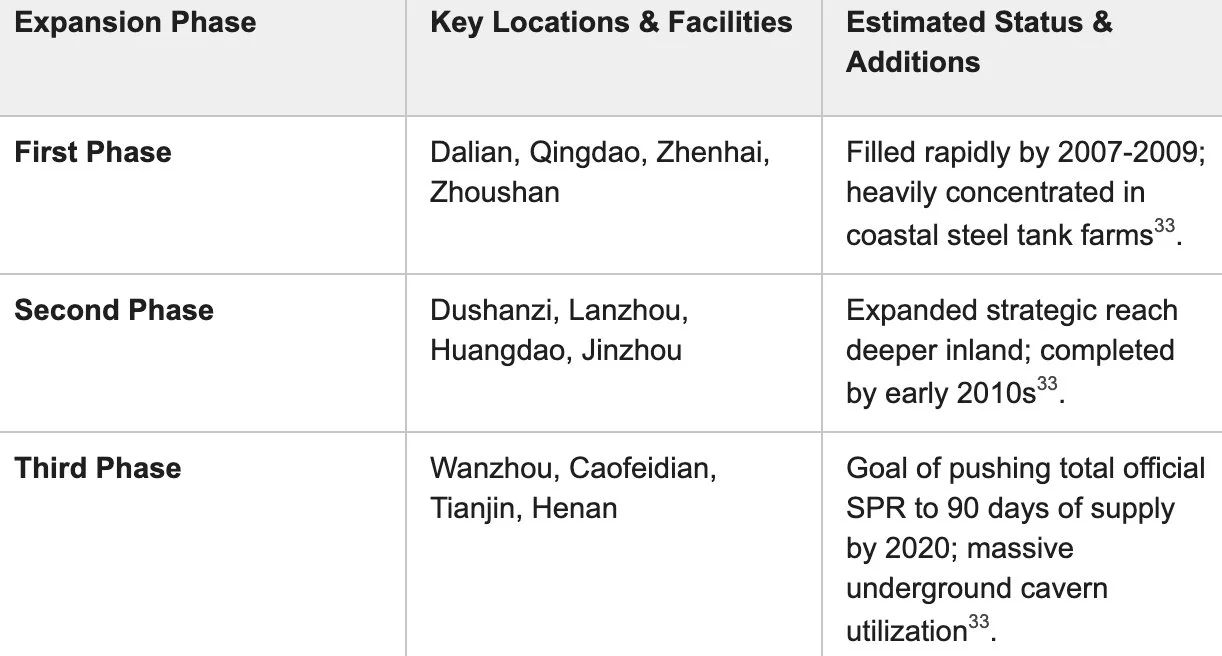
By 2026, the estimates for China's total storage capacity presented a spread of roughly 600 million barrels—a margin of error larger than the entire U.S. SPR.
- Kayrros estimated over 1.8 billion barrels of above-ground tank farm capacity as of mid-2024.
- Energy Aspects estimated total capacity at 2.0 billion barrels in December 2025, noting aggressive ongoing construction.
- S&P Global Commodity Insights reported that 271 million barrels of new commercial capacity across eight sites in early 2026 (including significant underground caverns in Fujian and Ningbo) would push total capacity above 2.39 billion barrels.
Structural Flexibility: Government vs. Enterprise Reserves
A defining feature of China's stockpiling strategy is the integration of state-owned and commercial reserves. In the United States, the government-owned SPR is strictly segregated from commercial inventories. Conversely, under China's 2025 Energy Law, corporate-held inventory carries a mandate of state responsibility. This allows the government to intervene and mobilize commercial stocks during a national emergency, effectively giving Beijing central control over both.
This layered architecture provides immense geopolitical flexibility. Beijing can utilize enterprise reserves as a first line of defense, preserving official government-owned strategic stocks for catastrophic disruptions, allowing intervention without immediately signaling a full-scale panic to global markets.
The 2025-2026 Inventory Accumulation
Utilizing this vast capacity, China aggressively purchased discounted, often sanctioned, crude oil during periods of market softness leading up to the crisis. The U.S. Energy Information Administration (EIA) estimated that China added an average of 1.1 million b/d to its inventories throughout 2025. This accumulation accelerated in early 2026, with stock builds averaging an estimated 1.24 million b/d in January and February.
By the onset of the Hormuz crisis, China had amassed the largest strategic stockpile in human history. The EIA and other tracking agencies estimated that China held nearly 1.4 billion barrels of crude oil by December 2025. Of this, approximately 360 to 401 million barrels were officially government-held, with the remaining ~1.0 billion barrels held by commercial refiners and state-owned national oil companies (NOCs). This inventory provided China with an estimated 110 to 140 days of net import cover, far exceeding the IEA's mandated 90-day minimum for its member states.
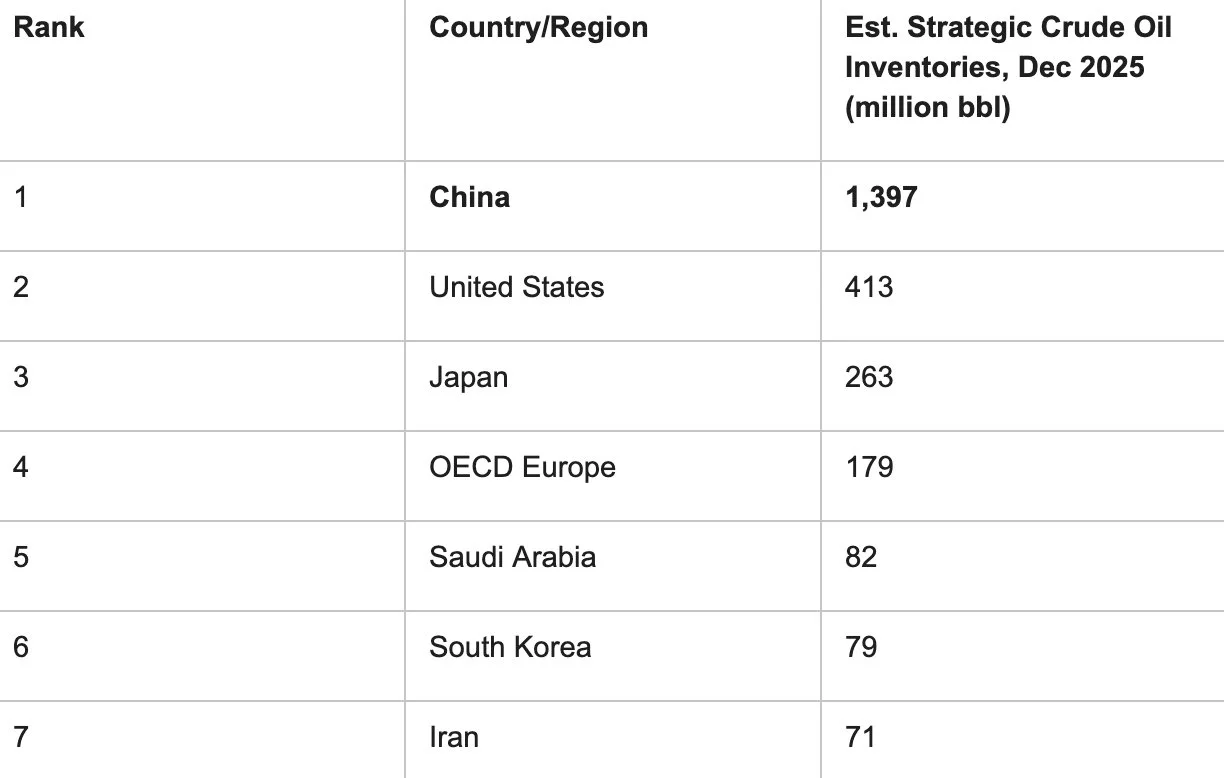
Data Source: U.S. Energy Information Administration estimates, compiled in 2026.
Resolving the Prisoner's Dilemma: Game Theory in Energy Security
The true macroeconomic impact of China's 1.4-billion-barrel stockpile during the 2026 crisis cannot be understood solely through static volume metrics. It must be analyzed through the lens of formal game theory, specifically the Hobbesian Trap and the Prisoner's Dilemma.
The Fear Spiral in Commodity Shocks
The Hobbesian Trap—named after English philosopher Thomas Hobbes, who described the "state of nature" as a condition of perpetual war where life is "solitary, poor, nasty, brutish, and short"—models bilateral or multilateral fear spirals. It explains why rational agents, driven entirely by a mutual fear of imminent betrayal or resource starvation, engage in preemptive, destructive actions. In formal game theory, this dynamic is modeled perfectly by the Prisoner's Dilemma, originally designed by Merrill Flood and Melvin Dresher in 1950 at the RAND Corporation.
The dilemma arises because, while mutual cooperation yields a higher aggregate payoff for all agents, defecting is the strictly dominant rational strategy for each individual agent in an isolated interaction. In international energy markets, an exogenous supply shock immediately thrusts importing nations into a high-stakes Prisoner's Dilemma.
When 14.4 mb/d of Gulf oil was abruptly removed from the market in early 2026, the strictly dominant rational strategy for any individual oil-importing nation was to "defect". Defection, in this context, means aggressively purchasing any remaining available spot cargoes at any price to secure domestic exergy needs and prevent localized industrial collapse. However, if all nations defect simultaneously, the aggregate outcome is a catastrophic price explosion (the Nash equilibrium of mutual destruction). This results in hyper-inflationary pressures, the collapse of discretionary income globally, and the severe degradation of global productive capacity. Historically, such hoarding panics defined the oil shocks of the 1970s, leading to a decade of macroeconomic stagflation.
China's Strategic Discipline
In 2026, China possessed both the immense financial liquidity and the available physical storage capacity to act as the most aggressive buyer on the spot market. Entering the crisis, its above-ground facilities were estimated to be only about 56% to 65% full, leaving ample room to hoard hundreds of millions of barrels of the remaining global supply. Had China chosen to defect, the price of Brent crude would have breached the constraints of standard economic models, plunging the global fiat system into a severe inflationary collapse regime as modeled by CBMT.
Instead, China demonstrated unprecedented strategic discipline. Relying on its 130+ days of import cover, Beijing chose not to chase barrels, effectively refusing to participate in the Hobbesian fear spiral.
The behavioral shift was stark. When the Hormuz supply shock hit, China's additions to storage plummeted from an estimated 1.24 million b/d in early 2026 to roughly 430,000 b/d by April. Furthermore, China allowed its total crude imports to slump dramatically, falling from 11.39 mb/d in February to 6.36 mb/d in May. To cover the domestic shortfall and ensure industrial continuity, China drew roughly 1 million b/d from its existing corporate stockpiles. Concurrently, to preserve domestic supplies without draining official strategic reserves, China completely halted its supplies of refined oil products to other countries.
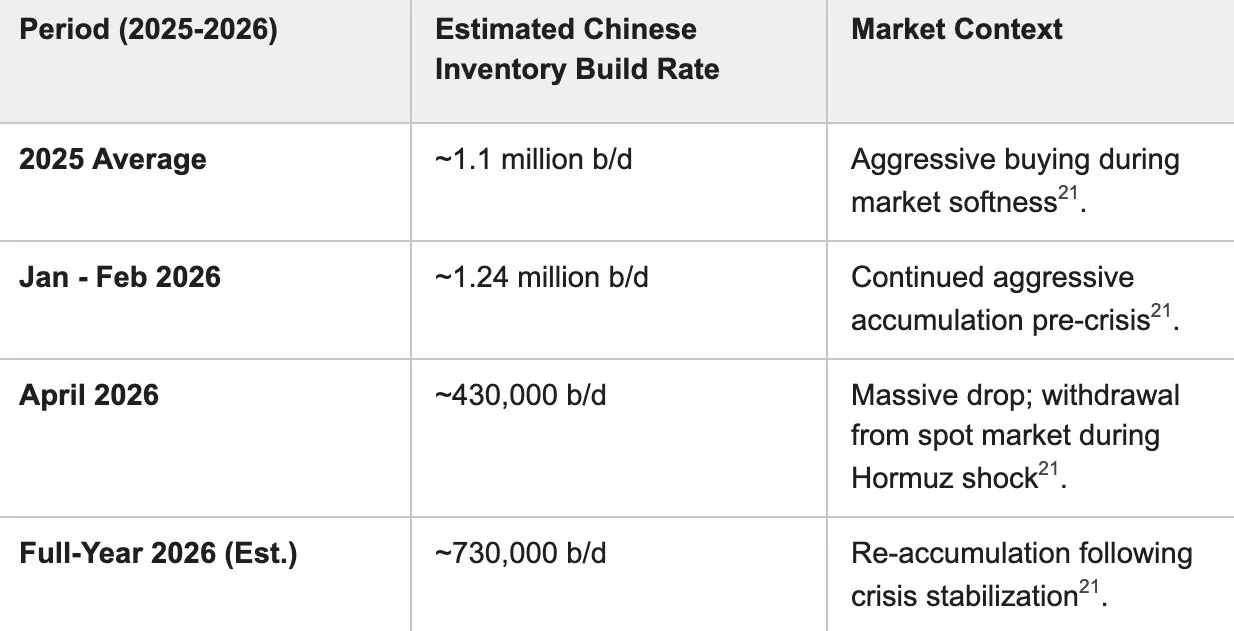
Data Source: Compiled from apparent-supply residuals, preliminary customs data, and consultancy forecasts (FGE, Vortexa).
This behavior—drawing on existing stocks and letting imports fall rather than paying astronomical premiums—is the hallmark of a buyer with profound cover and strategic foresight. By absorbing the volatility internally through its enterprise reserves, China withdrew from the global bidding war. China essentially enforced cooperation upon the global market equilibrium by sacrificing its own inventory accumulation, thereby preventing a terminal price spike and resolving the Prisoner's Dilemma.
Integrating the Fisher Thesis with Capacity-Based Monetary Theory
When Max Fisher's thesis is subjected to the rigorous ontology of Capacity-Based Monetary Theory, the profound geoeconomic depth of China's actions becomes clear. Under CBMT, a fiat currency derives its value strictly from the expected future productive capacity of its issuing society. Because exergy (useful work derived from primary energy) is the physical prerequisite for all productive capacity under the Ayres-Warr framework, a global exergy shortage acts as a synchronized structural attack on the asset backing every major fiat currency.
If China had panic-bought oil, the resulting price explosion would have shattered the capital and labor efficiency of both OECD and emerging markets. The operating costs for global manufacturing would have surged, and the discretionary income of the global consumer base would have evaporated, triggering demand destruction across all non-energy sectors. This would have severely degraded the aggregate labor and institutional stability vectors central to CBMT, diluting the value of monetary claims globally and manifesting as persistent, structural inflation and potential institutional collapse.
By strategically withdrawing demand and utilizing its SPR, China insulated the global exergy supply chain. It functioned as a systemic shock absorber. In saving the physical energy market, China preserved the aggregate productive capacity of the global economy. By extension, China stabilized the ontological foundation of the global fiat monetary system.
Geoeconomic Leverage and the RAND Assessment
The 2026 crisis validates long-standing assessments by defense and geopolitical think tanks regarding the shifting nature of energy security. A comprehensive analysis by the RAND Corporation warned that China's SPR has evolved far beyond a domestic economic policy device; it is now a formidable geoeconomic tool. The sheer size of the reserve affords China the unprecedented leverage to influence alliances, affect global supply chains, punish adversaries, or unilaterally stabilize the international system.
While the IEA's coordinated release of 400 million barrels provided necessary psychological liquidity to Western markets, mathematical realities dictate that the IEA's intervention would have been entirely overwhelmed had China—representing the world's largest marginal buyer—not concurrently suppressed its own demand. The 2026 event effectively demonstrated a transfer of the locus of global energy market stabilization from Western institutions to Beijing.
Energy Independence and Future Trajectories: The Capacity Shift
While China's 1.4-billion-barrel fossil fuel stockpile proved decisive in 2026, the long-term vector of its economic capacity under CBMT is increasingly tied to a structural transition away from imported crude. China's ultimate strategy for energy independence is not limited to hoarding raw materials; it involves a systemic technological transformation of its entire exergy supply chain.
The Peaking of Chinese Oil Demand
Data leading up to the 2026 crisis indicated that China's historical reliance on imported oil for economic growth was rapidly decoupling. Between 2003 and 2023, China accounted for over 50% of the growth in world oil demand, averaging an annual increase of 542,000 b/d. However, by 2024, demand growth decelerated sharply, prompting the country's national oil companies to aggressively revise their projections for peak oil demand. The China National Petroleum Corporation (CNPC) projected that China's oil demand could peak at 15.4 million b/d as early as 2025, while Sinopec capped its peak expectation at a maximum of 16 million b/d between 2026 and 2030.
New Energy Vehicles (NEVs) and High-Quality Exergy
This structural shift is driven by the hyper-accelerated adoption of New Energy Vehicles (NEVs) and the deployment of liquefied natural gas (LNG) in the commercial trucking sector. The NEV penetration rate in China surged from a mere 1% in 2015 to 41% by 2024, achieving its 2025 targets years ahead of schedule. In 2024 alone, NEVs displaced an estimated 28 million tons of gasoline in China, contributing to a 3.1% absolute decrease in gasoline consumption. By the end of July 2026, passenger car inventory in China's NEV industry reached 3.43 million units, capturing roughly 87.6% of the overall EV market share. Furthermore, Sinopec estimated that the rollout of LNG trucks would reduce China's diesel consumption by 5.5% in 2025.
Simultaneously, China is undertaking the largest renewable energy infrastructure buildout in human history. The country currently has over 500 gigawatts (GW) of wind and utility-scale solar capacity under construction—exceeding the combined total of the rest of the world. While grid bottlenecks and the intermittency of renewables present ongoing operational challenges, requiring massive battery storage arrays and ultra-high-voltage direct current (UHVDC) transmission lines (such as the proposed megabase line from Inner Mongolia to Shanghai) to ensure reliability, this buildout fundamentally alters China's macroeconomic exergy profile.
Long-Term Implications for CBMT Vectors
Under the Ayres-Warr thermodynamic framework, electrification and renewables represent a shift to higher quality energy vectors, vastly improving overall exergy conversion efficiency (useful work). By transitioning its transportation and industrial base to domestic electrical grids powered by renewables, nuclear energy, and domestic coal, China is systematically eliminating the vulnerability of its productive capacity to external maritime blockades and geopolitical supply shocks.
In the context of Capacity-Based Monetary Theory, this comprehensive energy transition represents a massive, compounding investment in the "Institutional Stability" and "Labor Efficiency" variables of the capacity vector function. As China systematically engineers its way out of dependence on the Strait of Hormuz, its future fiat capacity becomes inherently more robust and immune to the Hobbesian fear spirals of fossil fuel markets. If Beijing achieves true structural energy independence, the People's Bank of China will issue a currency backed by an exergy supply chain fully insulated from the geopolitical traps that have historically plagued fiat issuers, fundamentally altering the balance of global macroeconomic power.
Conclusion
The 2026 Hormuz oil shock served as an unprecedented empirical validation of the synthesis between Capacity-Based Monetary Theory, the thermodynamics of exergy, and international game theory. By viewing fiat money strictly as a floating-price claim on future productive capacity, the extreme vulnerability of the global economic system to physical energy constraints becomes starkly apparent. The Ayres-Warr framework confirms that exergy is the indispensable physical actuator of all economic capacity; therefore, a sudden collapse in global oil supply threatens not just localized energy markets, but the fundamental ontology of monetary value itself.
When confronted with a 14.4 mb/d disruption, the international system faced a classic, devastating Prisoner's Dilemma. The rational, self-preserving strategy for major energy-importing nations was to engage in panic buying—a defection that would have triggered a Hobbesian fear spiral, extreme price inflation, and a global collapse in productive capacity, echoing the stagflationary regimes of the 1970s.
The People's Republic of China, however, successfully bypassed this trap. Leveraging a massive geoeconomic architecture that included up to 2.4 billion barrels of storage capacity and a pre-positioned stockpile of 1.4 billion barrels governed by integrated state and corporate mandates, China exhibited extraordinary strategic discipline. By halting inventory builds, drawing down enterprise reserves, and restricting product exports, China effectively withdrew a massive quantum of demand from the global market. In doing so, it absorbed the extreme volatility of the Hormuz shock and shielded the global exergy supply chain from systemic failure.
China's actions preserved the structural integrity of global productive output, thereby indirectly defending the asset base of the world's fiat currencies—a reality that popularized the narrative that Beijing had "saved the world." However, while this intervention stabilized the short-term crisis, the broader macroeconomic trajectory indicates that China is moving aggressively toward absolute structural energy independence. Through the rapid deployment of NEVs, LNG freight, and renewable energy megabases, China is insulating its capacity vector from external energy constraints. In doing so, it is establishing a monetary and industrial foundation that is increasingly resilient to the volatilities of the fossil fuel era, setting the stage for a new paradigm of global macroeconomic hegemony.
-
News and Analysis | Stay Informed Today — Learn More - Flipp9 Consulting, https://flipp9consulting.com/news-and-analysis
Capacity-Based Monetary Theory and Game Theory: Resolving the Prisoner's Dilemma of Future Value : r/Economics - Reddit, https://www.reddit.com/r/Economics/comments/1rk6me0/capacitybased_monetary_theory_and_game_theory/
China quietly saved the world last month - YouTube, https://www.youtube.com/watch?v=BkA0bkb6ZO0
The Iran oil shock is about to hit - YouTube, https://www.youtube.com/watch?v=vFb_hb_npV4
MUST SEE - China quietly saved the world - with Max Fisher - YouTube, https://www.youtube.com/watch?v=awLcaYBwCr4
Not All Oil Price Shocks Are Alike: Disentangling Demand and Supply Shocks in the Crude Oil Market - American Economic Association, https://www.aeaweb.org/articles?id=10.1257/aer.99.3.1053
Total factor productivity - Grokipedia, https://grokipedia.com/page/Total_factor_productivity
https://drive.google.com/open?id=1SK0tQQFH6WB707BdxgUYS0m2CtmEwC4oAH0-zmxIsYo
Why the Ram shortage is unlikely to change... : r/LinusTechTips - Reddit, https://www.reddit.com/r/LinusTechTips/comments/1rf4zvr/why_the_ram_shortage_is_unlikely_to_change/
Decoding Solow's Model: Insights into Economic Development and Growth - Kumospace, https://www.kumospace.com/blog/solow-growth-model
Firm Investment in Energy Efficiency under Physical Energy Constraints - Spatial Economics, https://spatialeconomics.nl/wp-content/uploads/2025/10/STR_2025_Kusters-L.-Firm-Investment-in-Energy.pdf
The Economic Growth Engine - National Academic Digital Library of Ethiopia, http://ndl.ethernet.edu.et/bitstream/123456789/3104/1/83.pdf.pdf
Temporary prosperity or sustainable development: the long-run impact of developing pollution-intensive industries | Macroeconomic Dynamics, https://www.cambridge.org/core/journals/macroeconomic-dynamics/article/temporary-prosperity-or-sustainable-development-the-longrun-impact-of-developing-pollutionintensive-industries/08995E8B5C94DB84C6DEC8D145234EEA
Energy efficiency and economic growth: a coevolutionary perspective and implications for a low carbon transition, https://www.cccep.ac.uk/wp-content/uploads/2015/10/WP146-Energy-efficiency-and-economic-growth.pdf
Useful work and information as drivers of economic growth - ResearchGate, https://www.researchgate.net/publication/251609182_Useful_work_and_information_as_drivers_of_economic_growth
Results and implications of 1900-2010 exergy efficiency studies for the UK, https://www.internationalenergyworkshop.org/docs/IEW%202013_2A4Brockway.pdf
Oil Price Shocks and U.S. Economic Activity - University of Kentucky, https://gattonweb.uky.edu/faculty/herrera/documents/HKR_JEPO.pdf
Lower Oil Prices and the U.S. Economy: Is This Time Different? - Brookings Institution, https://www.brookings.edu/wp-content/uploads/2017/02/baumeistertextfall16bpea.pdf
The Effect of Oil Supply Shocks on U.S. Economic Activity: What Have We Learned? - University of Kentucky, https://gattonweb.uky.edu/faculty/herrera/documents/HRoil.pdf
Reassessing the U.S. Economy's Vulnerability to Oil Shocks, https://www.bostonfed.org/publications/current-policy-perspectives/2026/reassessing-us-economys-vulnerability-oil-shocks.aspx
How Much Oil Was China Adding to Its Reserves Per Day in 2026? - Project 54, https://projectfifty4.com/china-oil-stockpiling-rate-per-day-2026/
Ranked: The World's Largest Oil Stockpiles - Visual Capitalist, https://www.visualcapitalist.com/ranked-the-largest-oil-stockpiles-in-the-world/
China, the United States, and Japan hold most strategic oil inventories in 2025 - U.S. Energy Information Administration (EIA), https://www.eia.gov/todayinenergy/detail.php?id=67504
China's strategic petroleum reserve as a geoeconomic tool: A 'what if' exercise - RAND, https://www.rand.org/content/dam/rand/pubs/research_reports/RRA5000/RRA5069-1/RAND_RRA5069-1.pdf
North Korea just did the impossible - YouTube, https://www.youtube.com/watch?v=kSLsuADzOSk
Unreleased Footage Shows Lindsey Graham Cheering U.S. Strikes on Iran | WSJ News, https://www.youtube.com/watch?v=7xq_8nbZer4
China quietly saved the world last month - Reddit, https://www.reddit.com/r/China/comments/1uzgf68/china_quietly_saved_the_world_last_month/
Crude stocks in US strategic reserve fall 3 million barrels to lowest level since 1983 - Reddit, https://www.reddit.com/r/Economics/comments/1v0bdci/crude_stocks_in_us_strategic_reserve_fall_3/
China quietly saved the world last month - Max Fisher : r/Sino - Reddit, https://www.reddit.com/r/Sino/comments/1uz2udp/china_quietly_saved_the_world_last_month_max/
China Has 1.4 billion Barrels Strategic Oil Inventory, India 21.4 million - Deccan Chronicle, https://www.deccanchronicle.com/nation/world/china-has-14-billion-barrels-strategic-oil-inventory-india-214-million-1952282
How Much Oil Can China Actually Store? Capacity in 2026 - Project 54, https://projectfifty4.com/china-oil-storage-capacity/
Strategic petroleum reserve (China) - Wikipedia, https://en.wikipedia.org/wiki/Strategic_petroleum_reserve_(China)
Global strategic petroleum reserves - Wikipedia, https://en.wikipedia.org/wiki/Global_strategic_petroleum_reserves
China's Oil Demand, Imports and Supply Security - Center on Global Energy Policy at Columbia University SIPA | CGEP, https://www.energypolicy.columbia.edu/publications/chinas-oil-demand-imports-and-supply-security/
Oil Stocks of IEA Countries – Data Tools, https://www.iea.org/data-and-statistics/data-tools/oil-stocks-of-iea-countries
Global Energy Security Data - Short-Term Energy Outlook - U.S. Energy Information Administration (EIA), https://www.eia.gov/outlooks/steo/report/energysecurity/article.php
Oil Price Shocks and U.S. Economic Activity: An International Perspective - Resources for the Future, https://www.rff.org/documents/785/RFF-DP-10-37.pdf
Erica Downs Testimony - U.S.-China Economic and Security Review Commission, https://www.uscc.gov/sites/default/files/2025-04/Erica_Downs_Testimony.pdf
China Electric Vehicle Market Revenue to Hit USD 784.6 Billion by, https://www.einpresswire.com/article/926570575/china-electric-vehicle-market-revenue-to-hit-usd-784-6-billion-by-2035-at-14-80-cagr-thriving-global-demands-and-trends
China Massively Overproduces Electric Vehicles Prompting Global Fears of a Catastrophic Market Crash - Torque News, https://www.torquenews.com/17995/china-massively-overproduces-electric-vehicles-prompting-global-fears-catastrophic-market
China's renewable surge risks extending coal use amidst grid bottlenecks | Asian Power, https://asian-power.com/power-utility/in-focus/chinas-renewable-surge-risks-extending-coal-use-amidst-grid-bottlenecks
China's Renewable Megabases Still Send 42% Coal Power Through Key Grid Lines, https://onestopesg.com/esg-news/china-renewable-megabases-coal-transmission
China's strategic petroleum reserve as a geoeconomic tool: A 'what if' exercise | RAND, https://www.rand.org/pubs/research_reports/RRA5069-1.html
Double-click to edit...
Double-click to edit...
Double-click to edit...
Double-click to edit...
Double-click to edit...
Double-click to edit...
Double-click to edit...
Double-click to edit...
Double-click to edit...
Double-click to edit...

Strategic Capital Allocation in the AEC Sector: Navigating the AI Hardware Versus Cloud Computing Paradigm in 2026
Joshua Smith
The Digital Transformation and the 2026 AEC Landscape
The Architecture, Engineering, and Construction (AEC) sector in the year 2026 is undergoing a profound, accelerated, and largely irreversible digital transformation. This paradigm shift is fundamentally reshaping how the built environment is conceived, analyzed, constructed, and operated across its entire lifecycle. The industry has decisively moved beyond the experimental phases of basic 3D Building Information Modeling (BIM) and is now actively grappling with the integration of BIM 6.0, interconnected digital ecosystems, advanced artificial intelligence (AI), predictive digital twins, and automated project delivery systems.1 The financial magnitude of this shift is substantial; the AEC software market has reached an estimated $11.3 billion, reflecting a massive influx of capital into construction technology (ConTech), a sector which has seen total investments exceed 4x that number.2
However, this rapid digitization has introduced a uniquely complex infrastructural dilemma for AEC firm executives, Chief Information Officers, and BIM directors. As computational design methodologies, real-time clash detection, generative architectural algorithms, and predictive maintenance models become baseline requirements for competitive survival, firms are forced to make a critical strategic decision regarding their computational infrastructure.3 They must rigorously determine whether to continue relying on third-party cloud computing solutions—characterized by Software-as-a-Service (SaaS) platforms, remote data hosting, and perpetually variable operational expenditures (OpEx)—or to repatriate their intensive computational workloads by investing heavily in sovereign, on-premise AI hardware ecosystems.
This decision is not merely a peripheral matter of routine IT procurement. Rather, it operates as a fundamental determinant of an enterprise's future profitability, operational agility, and regulatory compliance. The rigorous analysis of this infrastructural dilemma requires an exhaustive evaluation of several overlapping and highly complex domains. These include the staggering data gravity generated by modern point clouds and reality capture workflows, the compounding and punitive financial costs of cloud data egress, the increasingly stringent data sovereignty mandates imposed by defense and international regulatory bodies, and the distinct limitations of probabilistic AI models operating within the deterministic, liability-heavy realm of structural engineering. By synthesizing empirical adoption data, hardware performance benchmarks, and evolving regulatory frameworks, this report provides a comprehensive, multi-layered analysis of the ideal computational infrastructure strategy for the modern AEC enterprise.
The Macroeconomics of Artificial Intelligence Adoption in AEC
To accurately comprehend the computational infrastructural requirements of the modern AEC sector, one must first deeply analyze the current velocity, depth, and nature of AI adoption across the industry. The integration of artificial intelligence in AEC is currently characterized by a stark bifurcation between technologically elite early adopters and a vast segment of the market that remains anchored to legacy, analog workflows.
Empirical Adoption Metrics and the Trajectory of Implementation
Empirical survey data collected throughout 2025 and 2026 provides a highly nuanced picture of this technological divide. Broad industry surveys indicate that approximately 55% of construction companies have already implemented some form of AI-based software within their operational frameworks.4 However, when filtering for deep, workflow-integrated AI used for complex automation, problem-solving, or critical decision-making, the adoption rate narrows to 27% of AEC firms.2 While this lower bound suggests that a significant portion of the industry remains cautious, the trajectory of adoption is overwhelmingly aggressive among those who have successfully crossed the technological threshold. An estimated 94% of AEC companies currently utilizing advanced AI plan to substantially increase their investment over the next fiscal year, signaling a decisive shift from isolated pilot programs to comprehensive, enterprise-wide workflow integration.5 Companies such as Czinger and Divergent3d actively utilize 3d design for the bleeding edge of hypercar and aerospace development, but they are actively working towards making these solutions mass market.27
Furthermore, the enthusiasm for this technology is broadly recognized by industry leadership, with 74% of AEC executives viewing artificial intelligence as a strategic opportunity rather than a competitive threat.4 The financial commitment to this opportunity is robust; 61% of AEC leaders plan to increase their AI investment by more than 10% in the upcoming year.4 Interestingly, this rapid adoption is not strictly the domain of massive, multinational engineering conglomerates. Small AEC firms, defined as those operating with fewer than 50 employees, have demonstrated an astonishing 150% increase in AI tool usage since 2022, leveraging commercial off-the-shelf algorithms to compete with much larger entities.4
Sectoral disparities in adoption also reveal distinct infrastructural priorities. The North American market currently leads global AI adoption in AEC with a 35% global share.4 Within the various sub-sectors of construction, infrastructure projects account for 30% of all AI-integrated construction spend, driven heavily by complex civil engineering requirements.4 Conversely, AI adoption in the residential construction sector is lagging behind commercial development by approximately 18%, reflecting the differing scales of capital and complexity inherent in these distinct markets.4
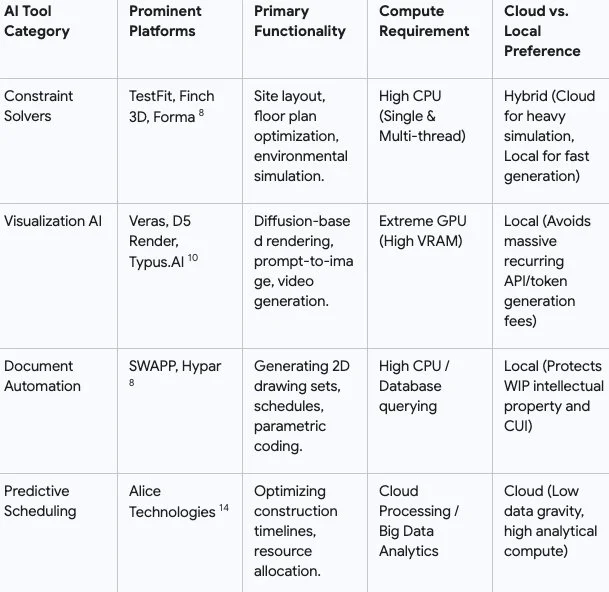
The ROI Imperative and Workforce Mitigation
The return on investment (ROI) for these early adopters is not merely theoretical; it is mathematically quantifiable and highly disruptive to traditional firm economics. The data reveals that 68% of firms utilizing deep AI integration have realized cost savings exceeding $50,000 per project lifecycle.5 Furthermore, nearly half (46%) of these early adopters report reclaiming between 500 and 1,000 billable hours by automating highly complex, repetitive tasks such as quantity takeoffs, clash detection, and basic document generation.5 In specific applications, automated takeoff software has demonstrated the capacity to reduce estimating time by an astonishing 80%.4
Beyond direct cost savings, AI is functioning as a critical strategic lever to mitigate severe demographic and labor crises within the construction and engineering sectors. The industry is currently facing a deficit of approximately 439,000 workers.2 In response to this acute shortage, 56% of survey respondents explicitly state that AI helps to offset the skilled labor gap by drastically amplifying the productivity of their existing workforce.5 Furthermore, advanced digital tools are increasingly viewed as essential for recruitment, with 44% of firms citing access to cutting-edge technology as a key factor in attracting and retaining top-tier engineering and architectural talent, ranking alongside corporate culture and base compensation.5
The "Dark Data" Paradox and Integration Frictions
Despite the profound efficiencies and high satisfaction rates reported by early adopters, the industry faces severe friction in achieving universal, seamless AI integration. The primary barriers cited by AEC leaders are not entirely cultural; they are deeply infrastructural, regulatory, and related to data quality.
A comprehensive analysis of integration challenges reveals that data sharing security (42%) and overall cost and complexity (33%) are the primary operational bottlenecks preventing wider adoption.5 Furthermore, 69% of industry professionals indicate that paralyzing uncertainty regarding impending AI regulations and legal liabilities has actively slowed their implementation efforts.5 To navigate this complex legal and ethical landscape, 33% of AEC firms have already hired dedicated "AI Ethicists" or specialized consultants to ensure compliance with emerging data frameworks.4
The Persistence of Analog Workflows
Perhaps the most significant paradox within the 2026 AEC landscape is the coexistence of advanced digital aspirations alongside deeply entrenched analog realities. While firms are eager to adopt predictive digital twins and generative design algorithms, the foundational data required to train these models is often inaccessible. Astonishingly, 53% of survey respondents admit to still utilizing physical paper during the design phase, and 49% rely on paper during the planning phase.6 Furthermore, 43% of the industry continues to rely on physical signatures and manual approvals rather than cryptographic digital signatures.6
This heavy reliance on analog workflows creates a massive "dark data" problem. It is estimated that 80% of all data generated during an AEC project is never reused or analyzed post-construction.4 Because this data remains trapped in physical documents or unstructured, isolated digital silos, it cannot be utilized to train bespoke, firm-specific machine learning models. Consequently, 22% of AEC leaders explicitly identify the lack of high-quality, structured data as the single greatest barrier to their AI adoption.4 Firms that fail to digitize their foundational workflows cannot leverage historical project data to improve future cost estimations, leaving them at a severe disadvantage against competitors whose AI models can analyze past performance to improve estimation accuracy by 25%.4
Software Typologies: Probabilistic Models vs. Deterministic Realities
To accurately determine the necessary computational infrastructure for an AEC firm, one must deeply understand the specific nature of the AI tools being deployed. The AEC sector requires absolute mathematical precision and rigorous adherence to physical laws, making it uniquely hostile to the purely probabilistic nature of generalized Large Language Models (LLMs) and standard text-to-image diffusion generators.
The fundamental challenge of integrating generalized AI into AEC is the tension between probabilistic generation and deterministic physics.8 Generative AI models are essentially highly sophisticated mathematical engines designed to predict the next plausible token, word, or pixel based on vast training datasets.8 They do not possess a native, underlying understanding of 3D parametric space, nor can they execute true mathematical or structural calculations.8 If a structural engineer asks an LLM to verify the load-bearing capacity of a steel beam, the AI will confidently generate text that syntactically resembles a structural calculation. However, it is not actually calculating the load; it is hallucinating a statistically likely response based on linguistic patterns.8
In the architecture and engineering disciplines, a hallucination is not a mere inconvenience; it is an existential threat. A minor error in spatial coordination or material specification can result in catastrophic structural failure, massive liability lawsuits, and severe building code violations.8 Furthermore, architectural plans and engineering schematics must be rigorously reviewed, signed, and stamped by licensed professionals who carry heavy legal liability. Because an AI algorithm cannot hold a professional license, assume legal liability, or guarantee deterministic accuracy, its role is strictly relegated to that of an assistive tool rather than an autonomous agent.8
Specialized AI Workflows in the AEC Stack
Because generalized models fail at deterministic physics, the AEC software market has evolved to produce highly specialized, task-specific computational tools. Understanding the processing requirements of these specific categories is critical for deciding whether to rely on cloud APIs or invest in local hardware workstations.
Feasibility, Massing, and Constraint Solvers
In the early stages of schematic design and site feasibility, tools like Autodesk Forma, TestFit, and Finch 3D dominate the landscape.8 TestFit, while frequently marketed under the umbrella of artificial intelligence, is more accurately defined as a highly sophisticated, real-time, rule-based constraint solver.8 It possesses the capability to generate up to 3,000 valid, code-compliant site plans—optimizing for complex variables like parking ratios and multi-family unit yields—in under 10 seconds on a standard machine.8
Similarly, Finch 3D utilizes advanced graph technology and generative algorithms to optimize residential floor plans within a predefined building envelope.8 Finch provides immediate, dynamic feedback on building performance metrics while ensuring that the generated outputs remain structurally reasonable, code-aware, and seamlessly integrated with parametric tools like Grasshopper.8 Autodesk Forma operates as a mature site and massing platform, running complex environmental simulations covering sun exposure, wind dynamics, noise pollution, and embodied carbon, subsequently connecting this data directly to Revit and Rhino.8 These feasibility tools are intensely computational, requiring substantial CPU resources to rapidly iterate through thousands of geometric permutations, though many leverage hybrid cloud-processing to offload heavy environmental simulations.
Visual Rendering and Diffusion Models
Generative AI has completely revolutionized architectural visualization, transitioning the industry from painstaking manual rendering to prompt-driven ideation. Applications such as Veras (acquired by Chaos), D5 Render, and Typus.AI utilize advanced diffusion models to generate photorealistic or highly stylized views directly from native BIM geometry.10
Veras, for example, integrates deeply with Revit, Rhino, SketchUp, and Vectorworks.10 It allows architects to lock in the deterministic 3D geometry of their model—using UI controls like "Geometry Override"—and use text prompts to explore material finishes, atmospheric lighting, and environmental contexts without ever leaving the BIM environment.10 The recent integration of the Nano Banana rendering engine has further extended Veras' capabilities to include AI-generated video, allowing designers to create short clips featuring dynamic camera pans and zooms.10 The computational burden for this workflow is extreme; generating high-resolution diffusion images and AI-upscaled videos requires massive GPU processing power and high VRAM capacity.
Document Automation and Generative Drafting
Drafting 2D construction documents remains the most labor-intensive and tedious phase of the AEC lifecycle. Innovative startups like SWAPP have emerged to attack this bottleneck by utilizing AI to automate construction documentation.8 SWAPP is designed to ingest a completed 3D BIM model and automatically generate highly detailed drawing sets, including sections, elevations, door schedules, and finish schedules.8 However, due to the rigid, bespoke nature of local building codes and the absolute necessity of human liability, the outputs generated by these automated drafting tools are not yet completely ready to be stamped and issued.8 They still require meticulous human oversight and manual annotation corrections, although they drastically reduce the raw hours spent on initial drafting workflows.8
Predictive Analytics, Scheduling, and Operations
Beyond the design phase, artificial intelligence is actively transforming construction management and physical site operations. Platforms such as Alice Technologies utilize AI-driven scheduling algorithms to optimize complex project timelines, resource allocation, and heavy equipment logistics.14 By analyzing millions of potential scheduling permutations, these systems can recover delayed timelines, optimize crane placement (reducing heavy lift time by 20%), and prevent an average of $500,000 in equipment downtime per large construction site through predictive modeling.4 Furthermore, 38% of engineering firms report using AI for predictive maintenance modeling, and energy optimization algorithms have been shown to lower operational building costs by 15% to 30%, with AI-powered HVAC controls specifically reducing energy consumption by up to 40% in commercial environments.4
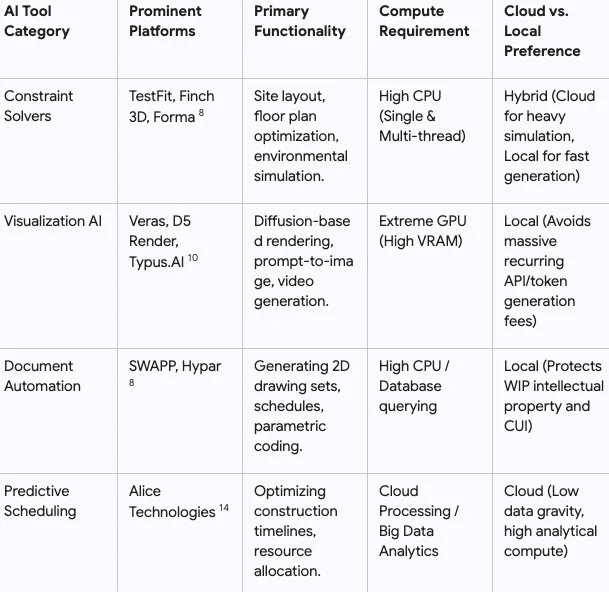
By meticulously categorizing these tools, a clear infrastructural pattern emerges. Tasks burdened by high data gravity and intense graphical rendering (such as diffusion rendering, point cloud meshing, and massive document generation) heavily favor robust on-premise processing hardware to avoid exorbitant API fees and latency. Conversely, analytical tasks dealing with lightweight text, numerical data, and scheduling permutations can comfortably and economically remain on secure cloud servers.
The Data Gravity of Reality Capture and Point Clouds
The primary technological driver forcing AEC firms to reconsider their unquestioned reliance on cloud infrastructure is the phenomenon of "data gravity." As digital datasets grow exponentially in volume and complexity, they become increasingly difficult, time-consuming, and expensive to migrate across networks. This massive data mass exerts a gravitational pull, forcing the requisite applications and processing power to relocate closer to the physical data source. In the contemporary AEC sector, data gravity is almost entirely driven by the rapid proliferation of reality capture technologies, specifically terrestrial laser scanning, LiDAR, photogrammetry, and drone mapping.
The Staggering Scale of Spatial Datasets
Point cloud processing is widely acknowledged as one of the most hardware-intensive tasks within the entire AEC technology stack.16 A point cloud is not a simple 3D mesh or a solid CAD model; it is a dense collection of millions, or often billions, of individual measured data points in a three-dimensional space.16 Each individual point contains precise XYZ spatial coordinates, laser intensity values, and frequently RGB color data, collectively representing the exact physical surface geometry of an object, building, or topography.16
The raw data generated by these reality capture methods is staggering in its sheer volume. A single terrestrial laser scan session—perhaps capturing just a few rooms—can generate between 10 and 50 Gigabytes (GB) of raw data.16 When this process is extrapolated across a full building documentation project, a complex industrial facility, or a wide-scale infrastructure survey, the resulting datasets frequently measure in the hundreds of gigabytes, and occasionally extend into the terabyte range.16
Processing this data involves highly complex spatial indexing and algorithmic searching. When a software platform executes a registration algorithm or a cleaning tool, it must perform spatial queries (e.g., mathematically locating all points within a specific physical radius of a defined structural column).16 To execute these operations interactively and without system crashes, the entire dataset—or highly significant portions of it—must be loaded directly into the workstation's Random Access Memory (RAM).16 This architectural requirement creates an immense bottleneck for standard commercial workstations and introduces a critical, often fatal, latency issue for cloud-based virtual machines.
Hardware Specifications for Localized Spatial Processing
To process these massive spatial datasets locally with acceptable efficiency, AEC firms must invest in highly specialized, sovereign hardware architectures that vastly exceed consumer specifications. The processing of point clouds demands extreme memory capacity, rapid storage bandwidth, and highly capable GPUs for rendering billions of points simultaneously.
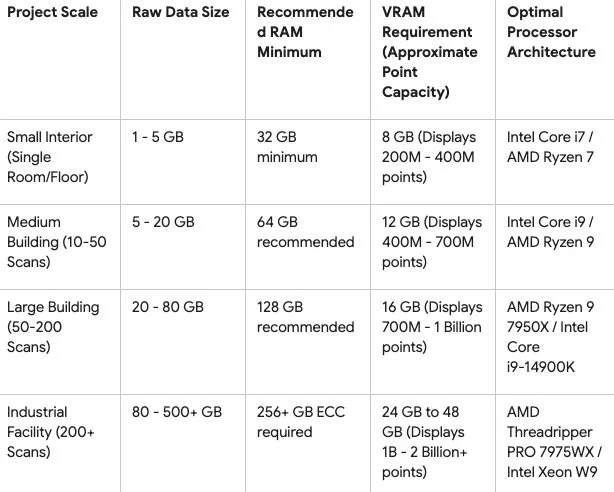
Data synthesized from comprehensive AEC hardware benchmarking and point cloud system requirements.16
The hardware specifications detailed above empirically demonstrate why remote cloud processing becomes a physical and economic liability for reality capture workflows. The general rule for point cloud processing dictates that a workstation's RAM should be at least twice the size of the largest working dataset.16 A firm regularly processing 40 GB point clouds requires an absolute minimum of 64 GB of RAM, though 128 GB provides a significantly more stable experience, as the operating system and the host software itself natively consume between 8 and 16 GB.16 A top-tier, industrial-scale workstation designed for these workloads requires 256 GB of DDR5 Error-Correcting Code (ECC) memory, an AMD Threadripper PRO CPU offering 8-channel memory bandwidth, and an NVIDIA RTX 4090 or professional RTX A6000 GPU to handle the interactive display of over two billion points.16
Furthermore, storage Input/Output (I/O) is frequently the most overlooked bottleneck in these systems. Point cloud files are heavily dependent on disk read/write speeds. Benchmarks prove that massive point cloud files load 5 to 10 times faster from a local PCIe Gen 4 or Gen 5 NVMe Solid State Drive (achieving read speeds exceeding 10,000 MB/s) than from a traditional SATA SSD, and 20 to 50 times faster than from a mechanical HDD.16
Attempting to execute this workflow on a remote cloud server introduces severe latency. Every rotation, pan, and zoom of a massive point cloud model requires continuous, real-time rendering. Pushing this dense graphical data from a cloud server to a local thin-client across a standard internet connection results in a degraded, lagging user experience that severely hampers productivity. Even in multi-user local environments where several team members access point cloud data from a central server, a 10 Gigabit Ethernet (10 GbE) network is considered the absolute practical minimum, as standard Gigabit Ethernet (1 GbE) is simply too slow for interactive spatial access.16
The Punitive Economics of Cloud Egress and Storage Rent
The immense data gravity of point clouds, coupled with the generation of high-fidelity AI renders and complex BIM models, transitions directly into the most critical financial argument against perpetual cloud reliance in the AEC sector: the punitive economics of data egress.
The Illusion of Cheap Cloud Onboarding
Cloud service hyperscalers—such as Amazon Web Services (AWS), Microsoft Azure, and Google Cloud Platform (GCP)—present an incredibly seductive initial proposition to AEC firms: zero upfront capital expenditure, highly managed infrastructure, and infinitely scalable storage. To incentivize adoption, these hyperscalers heavily subsidize the ingestion of data. Uploading terabytes of architectural models, LiDAR scans, and historical project data to the cloud is generally free or exceptionally cheap.
However, the economic trap of the cloud is triggered the moment an AEC firm attempts to actively retrieve, process, or migrate that data. This mechanism of wealth extraction is known as the data egress fee. In 2026, egress fees constitute a massive, and often entirely unanticipated, drain on AEC project profitability. Industry analyses confirm that cloud egress fees generally cost between 4 and 6 times more than the actual storage of the data itself.18
For a medium-to-large engineering firm actively collaborating on highly detailed 3D models, executing daily AI diffusion renders, and sharing massive point clouds, transferring 10 Terabytes (TB) of data out of the cloud over the course of a standard working month is a highly conservative estimate.
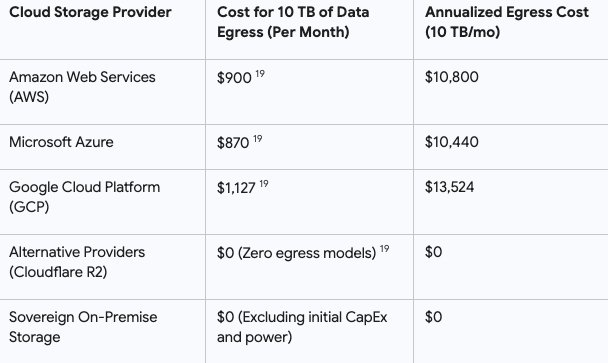
If an active firm scales its operations to 15 TB of egress per month on a platform like Azure, they face a staggering penalty of $1,665 monthly, translating to nearly $20,000 annually purely for the privilege of accessing their own data.18 When considering that major commercial or infrastructure AEC project lifecycles routinely span three to five years, the cumulative egress fees for a single project can easily exceed $100,000.
Total Cost of Ownership (TCO) and the Breakeven Velocity
By rigorously contrasting these continuous, compounding operational expenditures (OpEx) with the finite capital expenditure (CapEx) required to build sovereign hardware, a clear mathematical breakeven velocity emerges for the AEC enterprise.
A top-tier, industrial-scale AI workstation—equipped with a 32-core Threadripper PRO, 256GB of high-speed DDR5 RAM, 4TB of Gen 5 NVMe active storage, and a 24GB RTX 4090 GPU—costs approximately $15,000 to $20,000.16 If a firm relies heavily on cloud computing for iterative point cloud processing, continuous generative AI inference, and massive data sharing, the combined costs of virtual machine hourly rentals, AI API token consumption, and exorbitant data egress fees will mathematically eclipse the $20,000 hardware purchase price in less than 12 to 18 months.
Once the initial hardware CapEx is fully recovered, the on-premise infrastructure stabilizes into a predictable operational expenditure, operating at a marginal cost near zero (excluding electricity, cooling, and routine IT maintenance). This generates pure financial leverage for the firm over the hardware's standard four-to-five-year depreciation lifecycle. Therefore, for AEC firms consistently processing massive spatial datasets and generating high volumes of AI visual output, relying perpetually on the cloud is fundamentally an irrational destruction of enterprise capital.
The Regulatory Leviathan: Data Sovereignty and CMMC 2.0 Compliance
While the economic calculations regarding egress fees strongly favor the acquisition of on-premise hardware for high-throughput AEC tasks, the definitive and unyielding trigger forcing firms to repatriate their compute power is the rapidly evolving global regulatory landscape. In 2026, data sovereignty is no longer a peripheral IT concern or a theoretical best practice; it has calcified into an absolute contractual prerequisite for operating in the public, defense, and high-security private sectors.
CMMC 2.0 and the Protection of the Defense Industrial Base
For any AEC firm expecting to win, bid on, or participate as a subcontractor for projects funded by the United States Department of Defense (DoD), compliance with the Cybersecurity Maturity Model Certification (CMMC) 2.0 is an absolute, non-negotiable requirement.20
CMMC 2.0 is the measurement standard the government utilizes to enforce structure and rigorous oversight protocols for the handling and safeguarding of Controlled Unclassified Information (CUI) within the Defense Industrial Base (DIB).20 In the specific context of the construction and engineering industry, CUI is not limited to classified military weapon secrets. It encompasses a vast, sweeping array of standard project documentation. Architectural blueprints, structural specifications, as-built point clouds, site organizational charts, Requests for Information (RFIs), submittals, vendor emails, and facility management models for military barracks, federal courthouses, or critical national infrastructure are all legally classified as CUI or Federal Contract Information (FCI).20
The implementation of the CMMC 2.0 framework is occurring in strict, legally binding phases.22 By 2026, the industry has fully entered Phase 2, which radically alters the compliance landscape.22
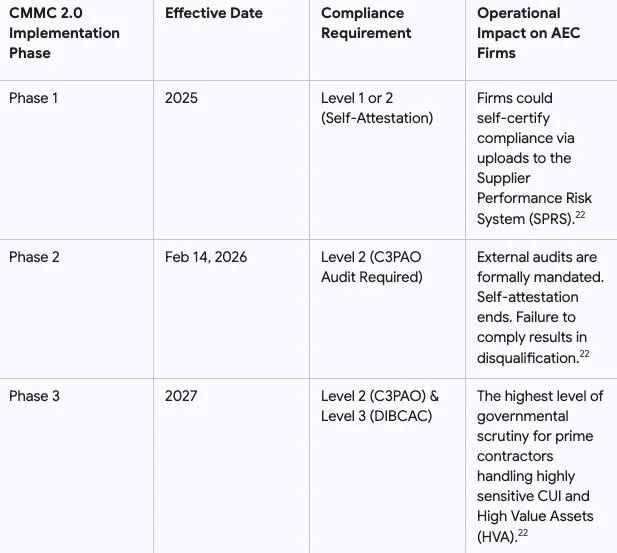
Crucially, CMMC compliance contains strict "flow-down" rules.20 This dictates that if a massive prime contractor secures a DoD construction contract, every single subcontractor, engineering consultant, specialized trade worker, and material supplier that touches the CUI must also be CMMC certified to the requisite level specified in the contract.20
This federal regulatory framework directly and forcefully impacts the strategic decision between cloud computing and on-premise hardware. Utilizing standard, multi-tenant public cloud AI tools (such as public web instances of ChatGPT, commercial Midjourney accounts, or non-compliant cloud BIM platforms) to process, analyze, or generate CUI is a severe violation of federal law. Cloud providers hosting this defense-related data must hold a minimum of FedRAMP Moderate Equivalency.20
Because navigating and licensing FedRAMP-compliant sovereign clouds (such as AWS GovCloud or Microsoft GCC High) is exceptionally expensive, disruptive, and technically complex—often requiring significant IT resources that smaller AEC firms lack—many organizations find that building air-gapped, sovereign, on-premise AI workstations is the most secure, legally defensible, and cost-effective method of guaranteeing absolute data sovereignty.21 By keeping sensitive blueprints and models entirely on local servers, firms effortlessly mitigate the risk of data leakage, protect their Supplier Performance Risk System (SPRS) scores, and seamlessly achieve CMMC Level 2 certification, thereby preserving their eligibility for highly lucrative federal contracts.
Information Governance: ISO 19650 and OpenBIM Standards
Beyond the specific requirements of United States federal defense contracts, the broader global AEC market is increasingly governed by ISO 19650, the internationally recognized standard for information management over the entire lifecycle of a built asset using BIM.24 ISO 19650 fundamentally rejects chaotic, ad-hoc file sharing, isolated data silos, and "Lonely BIM" practices, mandating instead a highly disciplined Common Data Environment (CDE) that acts as the single, agreed-upon source of truth for all project information.24
The Strict States of the Common Data Environment (CDE)
To achieve compliance with ISO 19650, an AEC firm's computational infrastructure must support the strict management of information containers as they transition through four rigorously defined states 24:
Work in Progress (WIP): Data is actively being developed by a specific authoring team (e.g., the structural engineering department). This data is strictly internal and must absolutely not be visible to or accessible by external project stakeholders or other disciplines.
Shared: Data is passed through a formal approval gate and shared with other disciplines for coordination, clash detection, and review.
Published: The final, verified information that has been formally authorized for construction, procurement, or contractual delivery.
Archive: A secure, immutable, and traceable record of all project data retained for legal compliance, audit trails, and future digital twin operations.
Public cloud AI platforms fundamentally disrupt and violate the WIP state. When an architect feeds a preliminary, unapproved design model into a public generative AI platform hosted on the cloud to explore stylistic variations or optimize floor plans, they are actively exposing unapproved WIP data to an external server environment. This action completely circumvents the strict state transitions, formal approval gates, and role-based responsibilities (Author, Checker, Approver) mandated by ISO 19650.24
Furthermore, ISO 19650 demands strict identification schemas, requiring unique IDs, systematic classification, and naming conventions that must be rigidly validated upon file upload.24 To maintain compliance, firms must either utilize highly specialized, pre-configured CDE platforms (such as Revizto, or SharePoint environments augmented by compliance applications like Flinker) 24, or they must utilize localized, on-premise generative AI tools.
By running AI inferencing locally on physical workstations, the firm maintains absolute sovereignty over its WIP containers. This guarantees that unvetted, AI-generated design variations do not accidentally propagate into the Shared or Published states without formal, documented human verification gates. It also aligns perfectly with the core principles of OpenBIM, an approach championed by buildingSMART, which emphasizes interoperability, vendor neutrality, and data sovereignty via open standards like Industry Foundation Classes (IFC) and BIM Collaboration Format (BCF).26 Operating local hardware allows AEC firms to interact with open formats without being forced into the proprietary, closed-ecosystem clouds of single software vendors, preventing vendor lock-in and ensuring data longevity across the decades-long lifespan of a built asset.26
Managing Capital Risk in a Hyper-Accelerated Hardware Cycle
A primary strategic argument frequently deployed against heavy capital expenditure in on-premise hardware is the fear of rapid technological obsolescence. Historically, enterprise server components and CAD workstations were reliably depreciated over a comfortable five-to-seven-year operational horizon. However, in 2026, the artificial intelligence sector is experiencing an unprecedented and violently disruptive acceleration in semiconductor development.
The undisputed global leader in AI compute acceleration, NVIDIA, has aggressively shifted from a traditional biennial architectural release schedule to a blistering one-year cadence. The market dynamics of this acceleration are staggering. The transition from the Hopper architecture (H100/H200) to the Blackwell platform (B200) brought a massive 4x increase in inference throughput, only to be almost immediately superseded by the announcement of the next-generation Vera Rubin platform. The Rubin architecture promises 5x greater performance than Blackwell and features an overwhelming 288GB of advanced HBM4 memory bandwidth.
This hyper-accelerated cycle induces a severe "Osborne Effect" within IT procurement departments—a market phenomenon where firms completely paralyze their purchasing processes, delaying necessary hardware upgrades out of the acute fear that currently available technology will be rendered mathematically obsolete within a matter of months. For an AEC Chief Technology Officer, investing hundreds of thousands of dollars into a cluster of Blackwell workstations in early 2026 presents a terrifying risk of capital destruction if the Rubin architecture is slated for imminent deployment.
Decoupling Foundation Training from the Inference Long Tail
To safely navigate this severe capital allocation risk, AEC executive committees must deeply understand the economic concept of the "inference long tail" and strictly decouple the two highly distinct phases of AI workloads: model training versus model inference.
Training a new, frontier foundation model requires the continuous operation of thousands of cutting-edge GPUs processing petabytes of data for weeks or months. This computationally immense task is strictly the domain of hyperscalers and base-model developers.11 Conversely, the daily operational output of an AEC firm consists almost entirely of inference—the localized, real-time application of a pre-trained model to a specific task. This includes rendering an architectural scene via Veras, solving a massing constraint via TestFit, analyzing a contract via Natural Language Processing (NLP), or indexing a point cloud.
Older hardware architectures maintain exceptional utility, speed, and financial viability for these inference tasks. A workstation equipped with an RTX 4090 or a professional ADA generation GPU may no longer represent the absolute frontier of semiconductor physics, but it remains incredibly fast and perfectly capable of executing AEC-specific inference workflows for up to six years. The physical capacity of the hardware to generate billable value does not degrade merely because a faster chip exists on the global market.
By applying localized token economics, AEC firms can calculate their internal breakeven horizon. If a mid-sized architecture firm utilizes local hardware to generate 500 AI renders a week, process 20 large point clouds a month, and automate the drafting of dozens of document sets, they can easily quantify the exact cost of executing those identical tasks on the cloud via API consumption and egress fees. If that cloud cost recovers the capital price of a local hardware workstation in four to six months, the threat of a newer, faster chip launching in eight months becomes entirely irrelevant. The hardware effectively pays for itself rapidly, mathematically nullifying the risk of capital destruction, and smoothly transitions into a state of generating pure profit capacity for the remainder of its physical lifespan.
Synthesis and Strategic Recommendations
The strategic decision between relying on ubiquitous cloud-based AI infrastructure and investing heavily in sovereign, on-premise hardware represents a defining operational crossroad for the AEC sector in 2026. Analyzed through the lens of empirical adoption rates, data physics, punishing cloud economics, and draconian regulatory frameworks, it is evident that a blanket reliance on public cloud infrastructure is no longer economically sustainable or legally defensible for firms operating at the frontier of digital construction.
To maintain a competitive advantage, preserve profit margins, and ensure institutional survival, AEC leadership must adopt the following strategic posture:
Repatriate High-Gravity Workloads: The laws of data gravity remain absolute. The staggering size of point cloud data and digital twins—frequently exceeding 100 GB per project—makes continuous cloud uploading, downloading, and network rendering economically ruinous.16 AEC firms must invest in local, high-RAM (128GB to 256GB ECC) and high-VRAM (16GB to 24GB+) workstations to process reality capture data locally. Doing so completely eliminates the crippling data egress fees charged by hyperscalers, which can easily exceed $10,000 annually for a mere 10 TB of monthly transfer.16
Mandate Sovereign Infrastructure for Defense and Regulatory Compliance: With the strict enforcement of CMMC 2.0 Phase 2 in 2026, the era of lax data security in federal contracting is decisively over.22 AEC firms handling architectural blueprints, structural diagrams, and project schedules for government contracts are legally handling Controlled Unclassified Information (CUI).21 Exposing this data to multi-tenant public AI platforms is a direct violation of federal law. Firms must establish air-gapped, sovereign AI hardware ecosystems to secure their data, maintain their SPRS scores, and remain eligible for highly lucrative DoD bids.20
Align Generative AI Workflows with ISO 19650 Standards: The integration of AI must not disrupt the strict Common Data Environment (CDE) state transitions mandated by global ISO 19650 standards.24 Unvetted, AI-generated outputs must remain rigidly confined to the internal Work in Progress (WIP) state.24 Localized AI processing ensures that proprietary design permutations are mathematically shielded from external exposure until human architects formally approve their transition to the Shared and Published states.
Deploy Specialized, Deterministic Assistive AI: AEC leaders must recognize and accept the inherent limitations of generalized LLMs. Because AI models are probabilistic engines mathematically incapable of deterministic physical calculation, they cannot hold professional liability, stamp drawings, or independently verify structural integrity.8 Consequently, capital should be strategically allocated toward highly specialized, localized assistive tools—such as Veras for diffusion rendering, SWAPP for automated documentation drafting, and TestFit for complex constraint solving.8
Mitigate the Osborne Effect via Accelerated ROI: AEC firms must not allow the aggressive 1-year semiconductor release cycle to paralyze their IT procurement strategies. By completely decoupling foundational AI training from daily operational inference, firms can leverage the prolonged utility of the "inference long tail." If the local generation of architectural renders, automated documents, and point cloud meshes yields operational savings that offset the initial hardware CapEx in a matter of months, the hardware investment is mathematically justified, regardless of impending architectural releases from hardware manufacturers.
Ultimately, the AEC firms that will dominate the remainder of the decade are those that adopt a highly sophisticated, hybrid computational posture. They will leverage secure, federated cloud environments exclusively for lightweight predictive scheduling, big data analytics, and inter-disciplinary communication, while aggressively deploying massive, sovereign on-premise compute clusters to dominate the heavy-gravity realms of generative visualization, reality capture, and secure defense contracting. Those who fail to internalize their most intensive computational workloads will find their project margins continuously eroded by perpetual cloud rent, their operational agility crippled by network bandwidth latency, and their institutional integrity irrevocably compromised by an inability to secure their proprietary digital assets.
-
The 2026 AEC Technology: BIM, AI, & Digital Twins - Tesla Outsourcing Services, accessed May 27, 2026, https://www.teslaoutsourcingservices.com/blog/the-2026-aec-technology-bim-ai-digital-twins/
2025 AEC Tech Industry Research Report, accessed May 27, 2026, https://www.aechub.org/insights/aec-tech-research-report-2025
Top Computational Design Trends Transforming the AEC Industry in 2026 - STRUCTUREX, accessed May 27, 2026, https://structurex.live/top-computational-design-trends-transforming-the-aec-industry-in-2026/
100+ AI In The Aec Industry Statistics | 2026 Data Report - WifiTalents, accessed May 27, 2026, https://wifitalents.com/ai-in-the-aec-industry-statistics/
New Bluebeam Report Shows Early AI Adopters in AEC Seeing ..., accessed May 27, 2026, https://press.bluebeam.com/2025/10/new-bluebeam-report-shows-early-ai-adopters-in-aec-seeing-significant-roi-despite-uneven-adoption/
Architecture, engineering, construction sector slow to adopt AI, survey shows - ASCE, accessed May 27, 2026, https://www.asce.org/publications-and-news/civil-engineering-source/article/2025/12/18/architecture-engineering-construction-sector-slow-to-adapt-ai-survey-shows
If digitalisation is here, why do half of UK construction firms still depend on paper?, accessed May 27, 2026, https://www.constructionbriefing.com/news/if-digitalisation-is-here-why-do-half-of-uk-construction-firms-still-depend-on-paper/8087847.article
Why AI Isn't Disrupting the Design Process in AEC Yet | e-verse, accessed May 27, 2026, https://e-verse.com/learn/why-ai-isnt-disrupting-the-design-process-in-aec-yet/
tankvn/awesome-ai-tools - GitHub, accessed May 27, 2026, https://github.com/tankvn/awesome-ai-tools
Veras - AI Spotlight Directory - AEC Magazine, accessed May 27, 2026, https://aidirectory.aecmag.com/entry/veras/
AI in AEC: A Company Guide - Motif, accessed May 27, 2026, https://www.motif.io/blog/ai-in-aec
Top 8 Best AI SketchUp Plugins Every Architect Needs in 2026 - D5 Render, accessed May 27, 2026, https://www.d5render.com/posts/best-ai-sketchup-plugins-2026
Chaos: from pixels to prompts - AEC Magazine, accessed May 27, 2026, https://aecmag.com/features/chaos-from-pixels-to-prompts/
AI Preconstruction Project Scheduling Software - ALICE Technologies, accessed May 27, 2026, https://www.alicetechnologies.com/product/preconstruction
AI Construction Scheduling: From Reactive to Predictive | Dan, accessed May 27, 2026, https://dancumberlandlabs.com/blog/ai-construction-scheduling/
Point Cloud Processing Hardware Guide | THE FUTURE 3D, accessed May 27, 2026, https://www.thefuture3d.com/blog/point-cloud-processing-hardware-requirements
3D point cloud | usBIM - ACCA software, accessed May 27, 2026, https://www.accasoftware.com/en/3d-point-cloud
What Are Egress Fees? The 2026 Data Engineer's Guide - Akave Cloud, accessed May 27, 2026, https://akave.com/blog/what-are-egress-fees-the-complete-guide-for-data-engineers
Cloud Egress Cost, accessed May 27, 2026, https://egresscost.com/
What is CMMC Compliance Today? - Infor, accessed May 27, 2026, https://www.infor.com/industries/aerospace-defense/what-is-cmmc-compliance
CMMC Compliant Construction Software - Kahua, accessed May 27, 2026, https://www.kahua.com/security/cmmc/
CMMC: Contractor Data Requirements on DOD Projects - Procore, accessed May 27, 2026, https://www.procore.com/library/cmmc-contractor-data-requirements
The Leading CMMC Compliance Solution - PreVeil, accessed May 27, 2026, https://www.preveil.com/cmmc-compliance/
ISO 19650 and SharePoint: Making Your Project Data Room ..., accessed May 27, 2026, https://flinker.app/blog/iso19650-sharepoint-cde/
Blog - BIM standards explained: ISO 19650, LOD levels, and BIM maturity in 2026 - Revizto, accessed May 27, 2026, https://revizto.com/resources/blog/bim-standards-level-of-information-bim
Open BIM - Catenda, accessed May 27, 2026, https://catenda.com/glossary/openbim-definition/
Behind the scenes of America's 3D-printed hypercar: Czinger | Capturing Car Culture w/ Larry Chen - Hagerty, accessed May 27, 2026, https://www.youtube.com/watch?v=te3FMxRnioo&t=4322s